Walter Tydecks
Flourishing of the Form
– Co-arising of Possibility Fields
Inhaltsverzeichnis
Abstract
Introduction
Category Theory of Mechanical Systems
Co-Arising (Aristotle, Nagarjuna)
Theory of evolution: from instruction to selection
Spencer-Brown
Example
The Flourishing of Identity in Storytelling
The Flourishing of imaginary number manifolds from the impossible
Abstract
Can the idea of an Interdependent Co-arising of form be seen in Laws of Form? Spencer-Brown's "Construction: Draw a Distinction" (LoF, 3) leaves open who is speaking here, who is being addressed and what kind of conversation it is. It contains four moments: the medium (the formable, distinguishable, void), in which the form is inscribed, and the drawing tools that are used and consumed during the drawing process and whose materials, such as ink, are also included in the drawing; the drawer (the distinguisher), who is spoken to with this request; the process of forming (drawing, distinguishing); the form (the sign, the difference), which as a result is produced. In the sense of Interdepent Co-Arising, the four moments are interdependent and can only arise together (cooperatively). Each of the moments is both active and passive. Western thought, on the other hand, sees the activity exclusively in the subject (the drawer, the distinguisher). For Western thinking, therefore, especially the idea that the medium is also active and not merely a passive material into which something is inscribed is unfamiliar. Equally uncommon is the idea that the resulting form has an activity of its own, with which it can both act back on the drawer and affect others who are attracted or repelled by that form. Even the process of drawing (distinguishing) has its own process form that can develop its own dynamics (second-order forms).
Question, thesis and objective of the article
Traditionally, laws are regarded as constant, almost unchangeable properties. Can a flourishing of form emerge from static laws of form, whereby the energy of form shows itself? Can the observer become less distanced from the forms they observe and enter into an open interaction with them, mediated though the medium? Has Spencer-Brown with his Laws of Form introduced a new understanding of laws and observers? The article is divided into 5 sections:
– The idea of Interdependent Co-Arising goes back to Aristotle and Nagarjuna (the Indian philosopher of Magayana Buddhism): A movement does not arise unilaterally by the effect of an active subject on a passive object, but from the interaction of the movable, the movable-capable and the resulting process of movement.
– Mathematical category theory has developed a framework for mapping the properties of static objects and the properties of their motions onto each other. This will be exemplified by mechanical spaces of motion (tangent bundles), quantum mechanical symmetry changes, and Spencer-Brown's relation of first- and second-degree equations.
– With the Darwinian theory of evolution, a paradigm shift from a strict, deterministic movement to an open, selecting movement has taken, in which possibility fields arise for both the movable and the moving-capable, from which the process of movement dynamically emerges. This is discussed with Ellerman in the language of category theory under the heading of 'adjoint functor pairs'.
– These results are applied to Spencer-Brown's Laws of Form. The three movements of forming, drawing and observing mutually condition each other.
– From this the result is given: If in a rigid system the dynamizable and the dynamizing-capable find each other, the flourishing of the rigid system into the liveliness arises from their interaction.
– The paper finishes with an example from the formation history of the arrow, which has become the most important operator in category theory, taking the place of statically conceived numbers.
Note: This article is based on a lecture at the Laws of Form Conference 2022 (LOF22) on August 5, 2022 in Liverpool, which was repeated on September 21, 2022 in a Hegel reading group at the University of Tübingen. Two paragraphs and two chapters have been added in response to the discussions and suggestions.
Category Theory of Mechanical Systems
The flourishing of a form is a movement that comes from within, shows itself outwardly, and causes a feeling of joy for every observer. Is there a formal figuration for this? For me, no work on logic shows such exuberant joy as the Laws of Form. Heinz von Foerster is said to have laughed out loud with enthusiasm again and again when he first read this book. What is the relationship between logic and joy?
First of all, the outdated idea of numbers, according to which they are nothing but unchanging quantities without inner movement and development, must be abandoned. Mathematics and logic had started with laws which are valid independent of space and time. The turn came with the study of mechanical movements. Whereas traditional natural science up to the Middle Ages primarily investigated the properties of given things, like their color, smell, weight etc. and on the numbers static properties like their divisibility, arrangement and their equivalence classes for instance in all even and odd numbers, with the experiments of mechanics variable quantities arose, the differentials, which have their own calculus. For a long time it remained open, in which way the modes of calculation with ordinary numbers and the higher analysis with differentials can be combined with each other. The answer arose at the beginning of the 20th century, when it was possible to describe the interaction of both calculi using graphical methods. This is best illustrated by the example of non-linear curves.
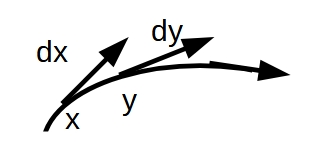
Fig. 1a Tangents along a curve
On one side there is a non-linear curve, the points of which are marked with x, y, on the other side the sequence of the respective straight-line tangents dx, dy, which are applied to these points. In mechanics, dx, dy corresponds to the respective instantaneous velocity along a path of motion at the points x, y. The differential calculus agrees with the ordinary calculus if the independent operations in both calculi come together again in the result and agree.
The tangents along a continuous, curved line constitute an inner connection. If a transition is made from one tangent dx to an adjacent tangent dy, this should correspond to a transition of the two continuously connected points x and y at which the tangents are applied. This example shows the method of category theory to represent this in two dimensions:
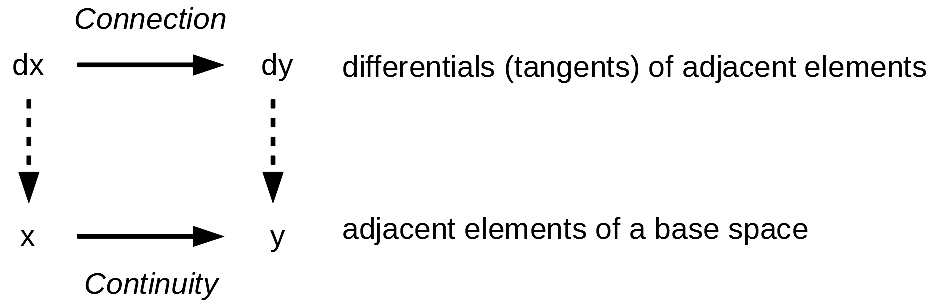
Fig. 1b Tangential bundle, commutative diagram
Mathematically, we speak of a commutative diagram in which two paths can be interchanged (commutated). This idea was extended during the 20th century. Not only tangents along a curve are considered, but also cotangents, local coordinate systems and symmetries (which are called fibers in general).
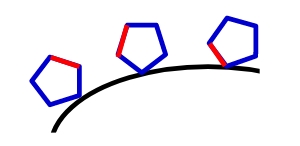
Fig. 2a Fibers along a curve
In this example, a regular pentagon is chosen as a symmetry that moves along a curve. The pentagon can not only change its position from x to y in the course of the movement, but can also rotate with its own movement (Eigenbewegung) and change the symmetrical properties of its outer sides. According to this idea, mathematically much more complex formulas are used to describe the properties of different forms of motion, from mechanical motion to particle physics and molecular biology. For each form of motion a certain symmetry is valid. In accordance with the tangents it shall be valid that the transition from one symmetry into an adjacent symmetry corresponds to the transition of adjacent points of a continuous function.
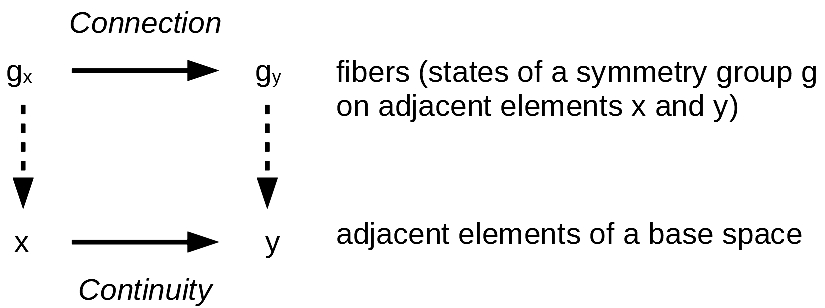
Fig. 2b Fiber bundle, commutative diagram
Is it possible to transfer this concept to Spencer-Brown's Laws of Form? Without going into this in more details here, it shall suffice to say that the first and second degree forms introduced by Spencer-Brown and his successors can be brought into a similar relationship:
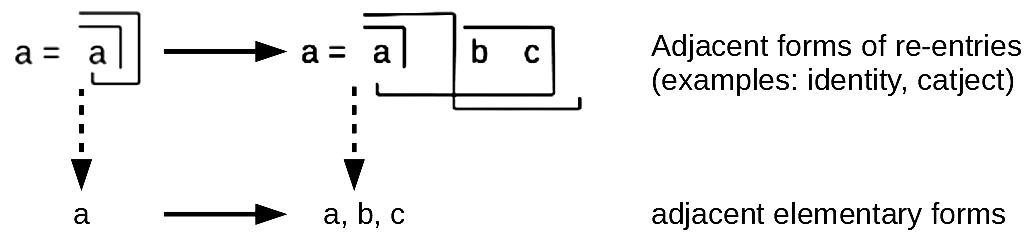
Fig. 3 Forms and re-entries, commutative diagram
In the lower line, the letters a, b and c represent forms of the first degree. These forms stand side by side, as is known from ordinary numbers. With the second-degree equations, Spencer-Brown has in Laws of Form chapter 11 found a higher form of how first-degree forms can be brought into infinite sequences, which, comparable to ordinary differential calculus, lead over a boundary transition into higher forms (second-degree forms) that contain a re-entry. The infinite movement of the return of the re-entry corresponds to the differentials (in Newton's expression, the fluxions). The relationships between the re-entries are comparable to the differential calculus. There are first examples of which reentries are to be considered. For an elementary form a, a re-entry can be formed that describes the going out of the form a into its other and the return from the other to itself. For three elementary forms a, b and c, a catject can be formed across the board, as recently introduced by Dirk Baecker (Baecker, 14, 57). Category theory can be used to ask whether there is a connection between second-degree equations that corresponds to the connection between fibers.
Co-Arising (Aristotle, Nagarjuna)
Furthermore, with the methods of category theory, ideas of the Indian philosopher Nagarjuna (ca. 2nd century) and Aristotelianism can be formalized and combined. From Nagarjuna is taken the insight that, contrary to Western thinking, no movement is a unilateral effect of a subject on an object (of an agent on his given item), but is composed of three moments that mutually condition each other. The classic example of this is the movement of walking. It can be formalized using the methods of category theory:
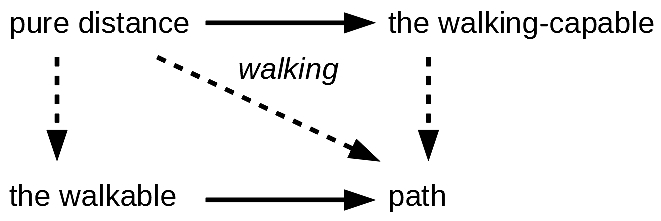
Fig. 4 Form a distance to the path
There can be no walking if there is no one who can walk and if there is no path that can be walked. Conversely, there can be no walker if there is no walking as a form of movement and if there is no path to walk. And finally, there can be no distance to be walked if there is no one to walk it and no form of movement of walking. This paradox can be generalized from the example of walking and transferred to counting, speaking, perceiving, distinction, forming, inscribing something in a ground, and so on.
Here, it is no longer simply the found results that are described with the co-arising of form, but the process of becoming. It follows its own process logic, which differs from the static logic of the given things. The process is an in-between (in German mittendrin, in Greek metaxy) between a beginning and an end, where it is still open whether the development will succeed and how it will look like in the result. The different moments of emergence are in flux and change each other. This becomes clearest with the number. Before there can be a number, there must be something that can be counted and something that can count. Both are initially only possibilities that must come together, and whether counting will succeed is initially open.
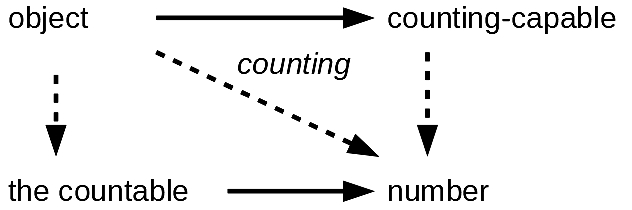
Fig. 5 From a counted object to a number
The countable and the counting-capable (and analogously the formable and the forming-capable, the distinguishable and the distinguishing-capable etc.) are not opposite to each other externally, but are in an interaction. The formable is, so to speak, awakened (aroused) in its formability by the forming-capable, and vice versa the forming-capable by the formable. Who can form, learns this ability only if he encounters formable. The formable triggers in him the ability of being able to form. This must already be present, but is activated only by the encounter with something formable.
I take the internal distinctions of number from Jeck, which he compiled from Aristotle's commentaries from Boethos of Sidon (in the 1st century CE) to Simplikios of Cilicia (c. 480-c. 560): In these, the following are distinguished: the countable (everything that can be count) (arithmeton), the countable itself (the respective individual object that is countable) (arithmeton auto), the counted (that which is counted) (arithmoumenon), the process of counting (arithmeisthai), the being that will count (arithmesontos), the counting being (arithmoun) (Jeck, 42).
Addendum 1: Margaretha Hendrickx asked: When speaking of the field of possibility of the capable, who is meant by the capable: In my understanding, first and foremost, of course, the respective human being who is capable of doing something. But it can also be a machine (e.g. the Turing machine, in which Wittgenstein saw an independent form of life [Lebensform] of the speaking-capable), the unconscious within us, the collective unconscious, a demon such as Descartes', the divine, etc.
Addendum 2: The reviewer for the publication in the journal Distinction has referred me to the preface by Spencer-Brown for the Limited Edition of Laws of Form from 1994, which I had not heard of before. There Spencer-Brown sees in the ideas of "conditioned coproduction, called by me the calculus of indications" his predecessor (Spencer-Brown 1994b, viii). He cites Sakyamuni, the name of Siddharta Gautama, the founder of Buddhism, as his source. He sees him as "the only other author who evidently discovered these laws" (Spencer-Brown 1994b, viii). In contrast to the "falseness of current scientific doctrine, what I call scientific duplicity: that appearance and reality are somehow different", he represents the idea of "triplicity". This leads him to formulations that come very close to those of Nagarjuna: "there can be no appearance that is not an awareness of appearance and, of course, no awareness that is not an appearance of awareness." (Spencer-Brown 1994b, vii). If I understand Spencer-Brown's preface for the German first edition of Only Two can play This Game correctly, also written in 1994, he became aware on September 7, 1970, through an enlightenment, that his thoughts and possibly he himself were a rebirth of Buddha's thinking (Spencer-Brown 1994a, 5). The relationship between the statements in the preface of 1994 and those of Nagarjuna and other philosophers such as Hegel, who also thought in terms of trinities, needs to be examined separately.
Theory of evolution and adjoint functor pairs: from instruction to selection
With the theory of evolution, the concluding step was achieved: Not only is the possibility considered of whether something can be processed and determined or whether something has the ability to do or to think something, but also the potential for the subject and the object to unfold into fields of possibility from which a multiplicity of processes can emerge. The rigid path of deterministic instruction is expanded into a multiplicity of possibilities from which one is selected. Ellerman formalized this with the methods of category theory.
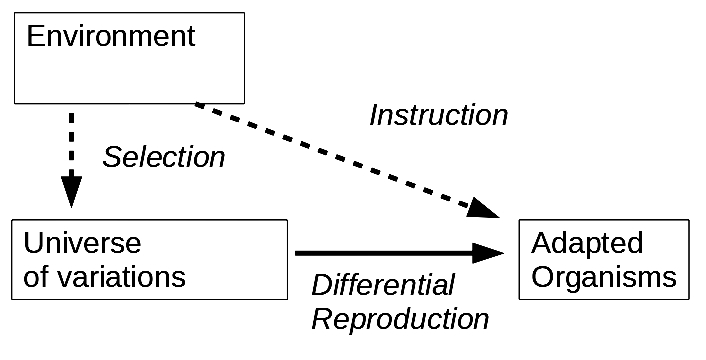
Fig. 6 Theory of evolution
Source: Ellerman 2007, 30, Fig. 8
Ellerman chooses his terms from pedagogy. Traditional pedagogy gives instructions: The teacher tells the student what to do and what to say. Students memorize the multiplication table and other arithmetic. They can and do it, but in most cases they don't know what they are doing and give up. Then they can be replaced by calculators and made redundant. It is similar with any other kind of work: instructions can be taken over by robots. Selection, on the other hand, means: the student learns to find his or her own way of calculating from an unknown variety of tasks and abilities. In my understanding, this corresponds to the power of judgment (Urteilskraft) meant by Kant and goes back to Aristotle's Nicomachean Ethics. This approach does not contain prohibitions and commandments and general instructions on how to act in which situation, but seeks to train the ability to judge and act independently.
Ellerman illustrates this with numerous examples. I choose the immune system as an example.
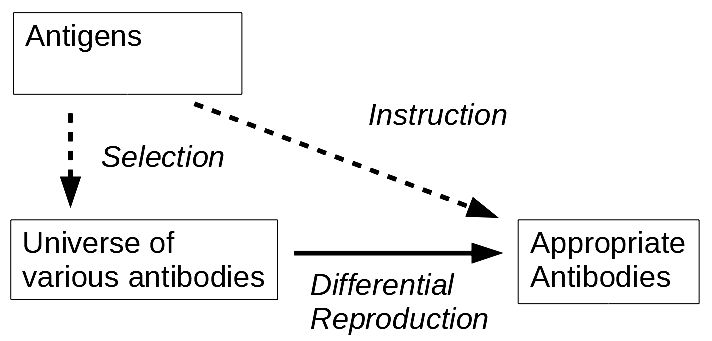
Fig. 7 Strict and flexible immune response
Source: Ellerman 2007, 32, Fig. 1
The body can react immediately to some pathogens (antigens) with a prepared response. This corresponds to the instruction. Overall, however, it is impossible to be prepared for all potential dangers with an exact response. Therefore, the immune system holds prepared responses that are still unfinished and are assembled and activated only at the moment of the respective danger.
Addendum: One participant points out: When the active and the passive (e.g., the formable and the forming-capable, or the counting and the counting-capable) interact and awaken and inspire each other, there is not only a one-way direction toward a result, but at the same time a reverse direction. This becomes particularly clear in the example of the immune system. If the immune system detects the weak points of an antigen and develops corresponding antibodies, the antigen also learns the other way round and forms new variants with which the defense is to be circumvented. See the recent examples of the Covid 19 virus mutations. As a result, there is not only a linear movement from a starting point to a result, shown here with the dashed diagonal arrows, but a second-order interaction that allows the relationships shown here to unfold spirally into a third level.
Spencer-Brown
In conclusion, this can be applied almost schematically to Spencer-Brown's basic concepts.
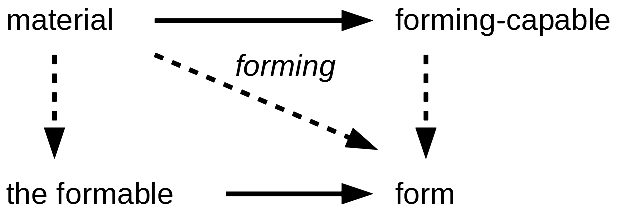
Fig. 8 From a material to a form
The formable and the forming-capable are changed and shape a material into a form in two ways (leftward and rightward).
And also the observer is no longer externally facing the thing he observes, but is in an interaction with it.
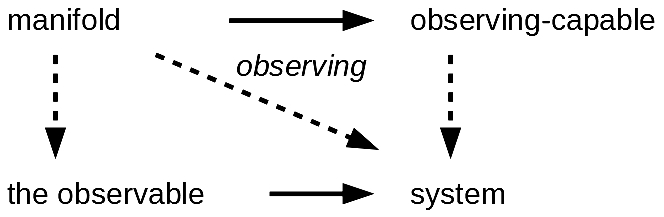
Fig. 9 Observer
Spencer-Brown suggested this when he introduced a re-entry of the second kind for the observer. The one who has read the Laws of Form and observed its content will subsequently understand himself better and could write the work anew and in an extended form.
Both the observed object and the observer change, transforming an indeterminate manifold into a system.
What is decisive is the interrelation of the two possibility fields with each other. When they find each other, it leads to flourishing. Every rigid system includes sides thanks to which it can be set in motion (dynamized), and the ability to set something in motion is awakened when it meets the suitable material.
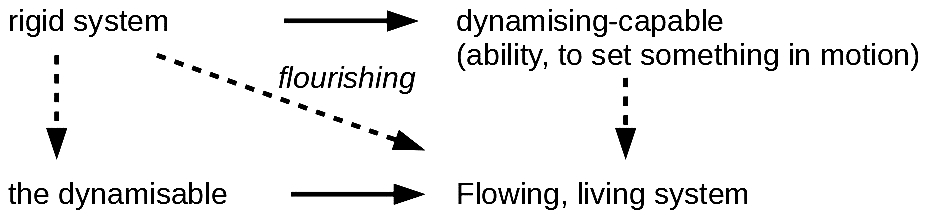
Fig. 10 Flourishing
As a sign of flourishing, I choose the symbol of goddess Vesta, who comes from Roman mythology and who lights the sacred fire of the domestic hearth and keeps it alive: ⚶.
Example: From a paving stone via a path sign to an arrow
Finally, an example is given which goes back to the prehistory of category theory. Category theory operates predominantly with arrows and no longer with numbers. This is preceded by a development first from objects to numbers and then from numbers to arrows. One of the earliest documented examples of the use of an arrow is a waymark in ancient Ephesus, on which a symbolized footprint is imprinted as an arrow on a pavement stone.
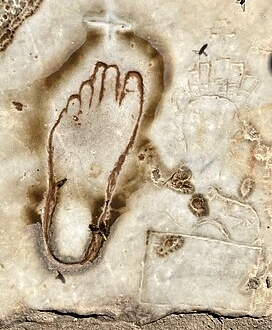
Fig 11, Directions to a brothel drawn in the pavement of a street, Ephesus, 1st century BCE
Source: https://upload.wikimedia.org/wikipedia/commons/thumb/4/40/Carved_footprint_in_Ephesus.jpg/512px-Carved_footprint_in_Ephesus.jpg
in: wikimedia.org

Robert J. Finkel took this image from Flickr and interpreted it in his article on the History of the Arrow:
One of the earliest evidences of an instructional illustration is that of a footprint next to a woman's face. This pictograph is inscribed into the pavement of the ancient Greek city of Ephesus (now present-day Turkey) around the first-century AD. It is a reductive set of directions to the local brothel. The two symbols, a footprint and the woman's face, when united is read to suggest, 'Walk in the direction that the foot is pointing towards to reach the brothel.
The footprint is prefigural: at the toes and the tapering of the foot with the middle toe and the big toe, the precursor of the arrow ↗ can be seen. And it is processual: it triggers the process of finding the way to a brothel. The processuality is the characteristic that has led to the formation of the symbol of the arrow.

Fig. 12 a,b Drawing and Symbolising
The Flourishing of Identity in Storytelling
Leon Conrad asks if the arrow and the example from Ephesus are a story. Those who are seeing this sign add to a story for themselves what those who followed this sign experienced.
In his lecture The Sense of Sentences, he asks, "What if there is more about sentences than we are taught at school?" A story is far more than a sequence of propositional sentences or even a form, such as the one given in this example with the waymark at Ephesus. It takes the listener out of their usual environment and draws them into the situation in which the story is set. It touches their own memories and expectations (in Husserl's terminology: their intentions, retentions, and protentions). In their imagination, comparable to daydreaming, they transcends the usual form (syntax) of ordinary language and enrich the words of the story with a wealth of unspoken meanings and feelings.
For me, therefore, the examples of the countable / counting-capable etc. mentioned so far should be extended in the direction of the nameable / naming-capable and the tellable / telling-capable. If we ask what is narratable, these are not merely the countable and measurable quantities to which conventional scientific research deliberately limits itself. Every story begins with names, such as: Once upon a time there was a little girl, Snow White, who lived behind the seven mountains, ... or imagine what happened to Sinbad the Sailor on Monkey Island ... Every name stimulates the imagination: What can the little girl or Snow White experience? What experiences do I want her to have and what do I want to protect her from? With each proper name, the listener is directly involved and imagines the world (the field of possibilities), with each proper name, the listener is directly involved and imagines the world (the field of possibility), what will happen and how they could witness it and intervene by themself. This creates the excitement that a good narrator is able to generate. The narrator sees and senses how the listener is involved and reacts. A good narrator will immediately respond to this. They will never tell the same story twice in the same way, but each time in a new way even for themself. Basically, they would have to rewrite the story each time. Every story has the inner power to stimulate the listener and inspire their imagination, as well as the storyteller themselves. The narrative will not appear to the storyteller as a fixed, static text, but as a field of possibilities in which they discover new, previously unseen variant with each new performance. With each new narration, they will allow themselves to be carried away anew by the energy of the narration, the storytelling and the attentive listeners. (I am also writing this as a thank you to Leon, whose storytelling talent has delighted me every time).
This has far-reaching philosophical significance: a person's identity is not a static concept (profile) with facts such as birthday, place of birth, nationality, age, marital status, profession, etc., but a narrative that flourishes from the interdependent process of hearing and telling, being capable of hearing and being capable of telling. This begins at birth: when parents give their child a name, they connect it with a narrative about the hopes and wishes they give the child, who this child wants to be and what it wants to experience. Furthermore, everyone forms a narrative of how they see themselves and others in their lives. These narratives are changed and updated with every new experience. A person's identity lies in the narrative of how they see themselves and how others see them. This identity will outlast death.
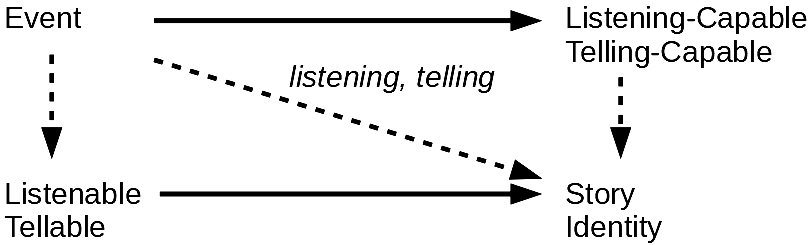
Fig. 13 Storytelling
In the co-arising of telling and listening, intersubjectivity is realized. Only that which has already been heard before can be told. Every story is addressed to listeners, and be it in a soliloquy, a meditation or a prayer to possible listeners, whose presence is experienced almost bodily. Every storyteller will experience how his narration changes him no less than his listeners, thanks to the reactions of others. There is a second-order storytelling of what happens in storytelling. This goes far beyond the pragmatics of working contexts, from which usually the emergence of language is supposed to be explained.
The Flourishing of imaginary number manifolds from the impossible
In her article Laws of Form and Husserl's 'Strange World of the Purely Logical', Claire Ortiz Hill referred to Husserl's remarks on imaginary numbers. By imaginary numbers, Husserl means not only the imaginary number i (square root of −1), as in conventional mathematics, but all non-natural numbers such as zero, the negative, fractional and, in a stricter sense, imaginary numbers, as early as 1890 in his letter to Stumpf (Husserl 1890, 245) and again explicitly in the double lecture of 1901 in Göttingen: "[I am of course taking the title imaginary as broadly as possible here, according to which the negative, even the fraction, the irrational number and the like can also be regarded as imaginary. Historically, only the imaginary in the sense of the negative and the lateral number has caused offense]". (Husserl 1901, 92, my translation using DeepL). These are numbers that do not result from counting or measuring material objects. There is nothing countable or measurable with a negative or imaginary number of elements. There is no measurable quantity that is smaller than 0 or imaginary. With fractional numbers it is at least possible to understand them as ratios a : b of two natural numbers a and b, e.g. 3 : 4 or 1 : 1000. However, it is not the ratio that can be counted or measured, but only the two quantities a and b whose ratio is being considered. There is no three-quarter or thousandth ratio of two numbers, but these would be ratios to be recalculated.
Anyone who still plays with numbers like a child with objects understands this immediately. If a child has learned to cut a piece of fruit and is told to break a number, they will laugh: "How should I hold the number in my hand and where should I start?" Broken numbers only exist in the imagination, they are imaginary. Like Spencer-Brown, Husserl is trying to find his way back to an original approach to numbers. We are so far away from this through education and habituation that it becomes difficult to understand Husserl's concerns and to find the right words to explain them. For example, when a bar of chocolate is broken in half, we say we have ½ bar. We remember that we have broken a whole bar and can now count how many pieces are in front of us. A distinction must be made here between two mathematical operations (which Husserl will understand as the first two levels of logic): When counting and measuring, we can only count and measure what is in front of us, be it whole or broken bars. (Such an "object [is] directly apprehended or itself present, which is constituted in the act of perception in a simple manner." Husserl 1921, § 46, 145; my translation) If the ratio of the number of pieces before and after breaking is compared, this is only possible if we compare the previous state with the given state in our minds. Before it was one piece, later it is two pieces. Husserl elaborated on what happens here in detail in his The Phenomenology of Internal Time Consciousness (Vorlesungen zur Phänomenologie des inneren Zeitbewusstseins), about work of his dating from 1904. Ratios like ½ are examples of »categorial« objects that are created through «acts of conjunction, disjunction, the definite and indefinite individual conception (that something), the generalization of the simple, relating and linking cognition« arise and belong to a higher level (Husserl 1921, § 46, 146; my translation).
In mathematics and arithmetic lessons, there is an unspoken leap in method at this Flourishing of the Form point. Whereas arithmetic calculation initially referred to given, countable things such as the fingers on a hand, apples or building blocks that lie in front of me and can be counted, geometrically arranged, or sometimes put together to form buildings, we now operate with purely mathematically defined objects that can no longer be counted or measured in themselves. They are not visible or otherwise observable, and certainly nothing can be built from zero or negative numbers. There are only jokes that achieve the impossible: "There are 5 people on a bus. At the next stop, 7 people get off. How many people have to get back on for the bus to be empty?" (bbq-treff.de Such numbers are in the realm of the unobservable. If it is nevertheless possible to calculate with them and produce results that are themselves countable and measurable, i.e., have found their way back into the realm of the observable (re-entry), Husserl describes this as the Transition through the Impossible (Durchgang durch das Unmögliche) – the title of his programmatic double lecture in 1901 at the Göttingen Mathematical Society.
Mathematics leaves the realm of the clearly explainable. Most teachers cannot explain it (but they can point to it), students have to memorize it. And yet these numbers are somehow given. For Husserl, this is the question of givenness: when is something considered given, and when is it only claimed to be given? How can we check whether it is really given? Do things with a negative count or size only exist in a fantasy world, as we know it, for example, from Lewis Carroll's Through the Looking-Glass, and What Alice Found There?
The previous examples of independent co-arising need to be extended once again. While the relationships in counting and measuring were clear (there is something that can be counted or measured, and there is something that can count or measure it), things became more complex in narrating and hearing. In narration, pairs of the active and passive appeared on both sides of the tellable/listenable and the telling-capable/listening-capable: What is narratable must also be audible, and whoever can narrate must also be able to hear (and vice versa: what is audible must be narratable, and whoever can hear must also be able to narrate, at least in order to report back to the narrator whether and how the listener has understood them).
According to Husserl, the relationship between telling and hearing is generalized to the relationship between giving and taking and the variety of possibilities (the field of possibilities) of giving and taking, among which Husserl will distinguish three classes, each with its own logic. Telling can be understood as the giving of messages, and hearing as their taking (the German words 'vernehmen' and 'aufnehmen' contain the root 'nehmen'. This cannot be translated literally). The terms 'giving' and 'taking' provide the framework for understanding what Husserl is concerned with. For every given there is a variety of givennesses. Husserl initially thinks of very simple examples: A house is given differently whether it is seen from the front or the back, by the neighbors or by participants at a garden party. It is given differently when its architectural floor plan is viewed, or when potential buyers or tenants inspect the house to see whether it is comfortable for them to live in. 'Giving' can mean: giving a thing its form. A thing gives itself to be recognized. For every giving there is given a multitude of givenesses.
There are not only sensorially perceptible things, such as the pebbles (calculi) with which counting and arithmetic were learned (from which the term 'calculus' is derived), of which Husserl writes: "In the sense of the stricter 'sensory' perception, an object is directly grasped or itself present, which is constituted in a straightforward way in the act of perception." ("Im Sinn der engeren 'sinnlichen' Wahrnehmung ist ein Gegenstand direkt erfaßt oder selbst gegenwärtig, der sich im Wahrnehmungsakte in schlichter Weise konstituiert." Husserl 1921, § 46, 145, my translation using DeepL). Dreams, works of art, thoughts and overarching entities such as water (hydor) in continuous motion in the sense of Thales and Heraclitus are to be distinguished from this. Husserl refers to them as "the categorial or ideal as the objects of the higher levels" (Husserl 1921, § 46, 145, my translation using DeepL) and goes on to give his own examples: "Color, house, judgment, desire are purely sensory concepts; colorfulness (being colored), virtue, parallel axiom, and the like are categorially mixed; unity, majority, relation, concept are purely categorial." (Husserl 1921, § 60, 184, my translation using DeepL). categorial or ideal objects can neither be counted nor measured. What is the number or size of dreams or of water as a whole? What makes a great work of art? But they can be calculated on! That is the special feature of imaginary numbers, whose ontological status has not yet been clarified by mathematics. If we succeed in understanding how to calculate with them and, above all, how imaginary numbers return from the realm of the impossible to the real world, then these numbers will make it possible to develop calculation methods for the other objects of the higher levels and to use them to "recalculate", as it were, how fantasy moves away from reality and returns to it. Husserl drafts the idea of a completely new understanding of mathematics.
On the other hand, there is a variety of ways of taking and hearing, for example when I hear the wishes and concerns of another person and understand them intuitively and compassionately without reducing them to specific objects, or understand what a composer and interpreter of a musical work wants to say to me without being able to find words for it. The givenesses on the one hand correspond to the intentions, memories and expectations (retentions and protentions) on the other. This gives for me an overview of some of Husserl's basic concepts:
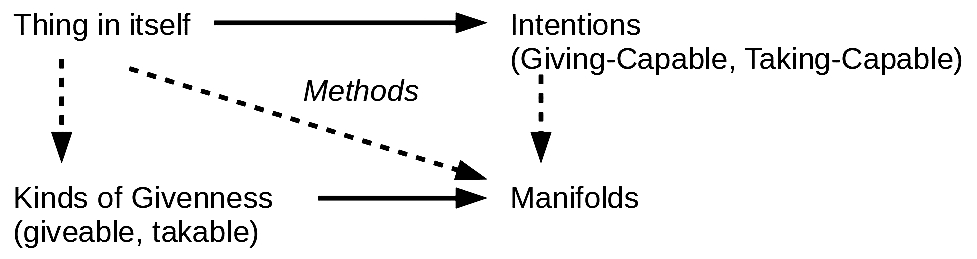
Fig. 14 The Kinds of Givenness and the Kinds of Being Capable of Giving and Taking
The example of negative numbers shows the direction this takes: In thought, it is possible to oversee processes and their inner movement and contradictions. There is nothing whose number or size is negative, but there are balancing processes. When a lever arm rises on one side, it sinks on the other. When someone lends money to someone else, he receives a document that he can redeem later with the repayment. Conversely, the borrower (creditor) has a debt on his account. These processes are the only way to understand what is meant by negative numbers such as a negative account balance (see Kant in his 1763 Attempt to Introduce the Concept of Negative Quantities into Philosophy). Like the axiom of parallels mentioned by Husserl, balancing processes are an example of "objects of the higher levels".
Without deepening or expanding on these examples, Husserl's insight is that each kind of givenness and the corresponding kind of taking-and-hearing-capable determines the giving and taking specific to it. The two fields of possibility of giving and taking lead to a third field of possibility of methods. There is not one method for giving and taking, comparable to the method of counting in the relationship between the countable and the counting capable, but rather a variety of methods. Within this diversity, balancing processes can occur between the different methods.
Self-referentially, the methods can be used to infer the underlying forms of theories (Theorienformen) in order to explain the safety, comprehensibility, applicability and simplicity of the associated method. Husserl did not work this out further, but saw this as the highest task of philosophy. The questions about the transition from ordinary to imaginary numbers and back from imaginary numbers to ordinary numbers (re-entry) can only be clarified with the form of theories.
"On the basis of a sufficiently developed solution of the given tasks, it becomes possible to formulate multiple concepts of possible theories from purely categorial concepts, pure 'forms' of theories whose essentiality is legally proven. However, these different forms are not without relation to each other. There will be a certain procedural order, according to which we will be able to construct the possible forms, to survey their lawful connections, and thus also to transform the one into the other through variation of determining basic factors, etc. There will be, if not in general, at least for the theoretical forms of certain defined genera, general propositions which, within the defined scope, will govern the lawful development of the forms, their interconnection and transformation." (Husserl 1913b, § 69, 247, my translation using DeepL)
"This is the ultimate and highest aim of a theoretical science of theory in general. It is also not an indifferent one from an epistemological-practical point of view. Rather, the classification of a theory into its form class can be of the greatest methodological importance. For with the expansion of the deductive and theoretical sphere, the free vitality of theoretical research also grows, the richness and fruitfulness of the methods increases." (Husserl 1913b, § 69, 248, my translation using DeepL)
These three sides mutually awaken each other in the flourishing of the cognition of a manifold / form of theories, in which Husserl distinguishes three stages of logic:
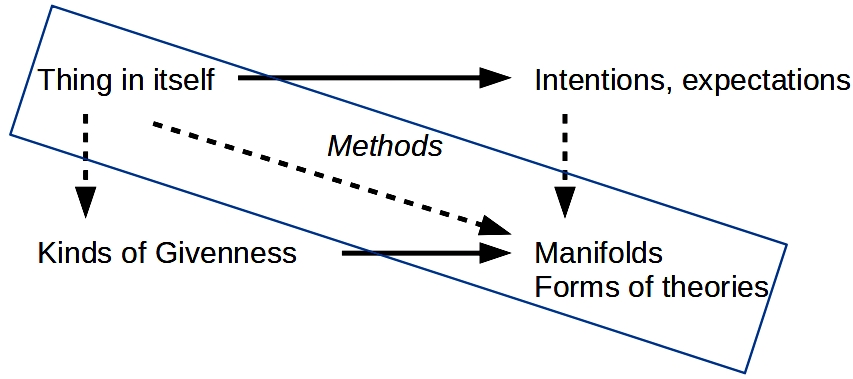
Fig. 15 Three levels of logic according to Husserl
For Husserl, the forms of theories reach the stage at which manifolds of mathematical objects can be determined and freely operated with. The impossible numbers did not simply emerge from more or less arbitrarily defined calculations, but from the handling and practical applications of them it is possible to conclude the theoretical forms given with them, which Husserl connected with the ordinary objects in his design and explained from them. For me, this development can be described as a flourishing of the forms that are already given with the ordinary objects and lead far beyond them. If we think of the diversity of categorial objects from dreams to axiom systems and the like, this flourishing can be associated with the revelation of the divine, just as Hegel saw it for the course of the science of logic.
In her contribution Husserls 'Mannigfaltigkeitslehre' from 2000, Claire Ortiz Hill refers to a passage in Husserl's 1917/18 lecture Logic and General Theory of Science: "The circumstance then that, instead of in the specific fields of knowledge, one can operate rather in the spheres of pure forms, and if they are complete can freely operate, then leads to systematically broadening the complete discipline-forms there and to pursuing all possibilities of the construction of complete disciplineforms. " (Husserl 1917/18, § 57, 265). In her own words: "One may then, he concluded, operated freely within a multiplicity with imaginary concepts and be sure what one deduces is correct when the axiomatic system completely and unequivocally determines the body of all the configurations possible in a domaine by a purely analytical procedure." (Hill 2000, 175)
Husserl oriented himself on the point manifolds introduced by Cantor, and conversely, Cantor's work on the power and order types of the number classes can be re-read from Husserl's findings. We must ask about the power (the energy) of form, which leads to its flourishing both on the side of the givenness and on the side of the intentions and the forms of theories. Cantor named them with letters of the Hebrew alphabet, studied their occult (hidden) properties and presumably saw in them the stages of infinity to the divine. A planned work will deal with this.
The result is open. As Claire Ortiz Hill has pointed out in other books with evocative titles such as The Road not Taken, in the 20th century the roads and directions going back to Frege and Husserl became separated and alienated from each other. Through his relationships with Wittgenstein and Russell, Spencer-Brown was on the whole on the their path traced back to Frege and probably neither knew Husserl nor was he made aware of him from his friends and colleagues. Claire Ortiz Hill's contribution provides an initial impetus as to how both can learn from each other and - albeit belatedly - find their way onto the road not taken. Anyone who wants to continue working on the topics mentioned by Husserl will find inspiration in Spencer-Brown, especially when it comes to understanding what is meant by form. Husserl sees form as the result of abstraction and formalization until its "pure form" is achieved (see e.g. Husserl 1929, §§ 6, 26). With Spencer-Brown, we can learn how form, for its part, is a content to be studied in its own right, with its own laws and developments. In the other direction, further research on Spencer-Brown's work with Husserl can find a new understanding of its basic assumptions and, for example, no longer simply say, "We take as given the idea of distinction and the idea of indication" (Spencer-Brown 1969, 1), but with Husserl ask about the modes of givenness and recognize which implicit restrictions for givenness have been presupposed and can be extended.
References
Vladimir I. Arnold: Mathematical Methods of Classical Mechanics, New York 1989 [1974]
Dirk Baecker: Katjekte, Leipzig 2021
David Ellerman (2007): Adjoints and emergence: applications of a new theory of adjoint functors
in: Axiomathes (2007) 17:19-39, DOI 10.1007/s10516-007-9008-x
David Ellerman (2015): On Self-Predicative Universals in Category Theory
in: arXiv:1405.3192 [math.GM], Submitted on 9 May 2014 (v1), last revised 11 May 2015 (this version, v2)
Robert Finkel: History of the Arrow
in: printinghistory.com vom 1. April 2005, unter: https://printinghistory.org/arrow/
Claire Ortiz Hill, Jairo José da Silva: The Road Not Taken, London 2013
Claire Ortiz Hill (2000): Husserl's Mannigfaltigkeitslehre
in: Claire Ortiz Hill, Guillermo E. Rosado Haddock: Husserl or Frege?, La Salle 2000, 161-178
Claire Ortiz Hill (2022): Laws of Form and Husserl's 'Strange World of the Purely Logical'
unter: ResearchGate, https://www.researchgate.net/publication/362598990_Laws_of_Form_and_Husserl%27s_Strange_World_of_the_Purely_Logical
Edmund Husserl (1890): Brief an Stumpf, wohl Febr. 1890
in: Husserl: Studien zur Arithmetik und Geometrie (1886-1901), Husserliana XXI, Den Haag u.a. 1983
Edmund Husserl (1901): Durchgang durch das Unmögliche, Doppelvortrag 1901,
in: Elisabeth und Karl Schumann: Husserls Manuskripte zu seinem Göttinger Doppelvortrag von 1901, in: Husserl Studies 17: 87-123, 2001
Edmund Husserl (1913a): Ideen zu einer reinen Phänomenologie und phänomenologischen Philosophie, Halle a.d. Saale 1913
Edmund Husserl (1913b): Logische Untersuchungen, Erster Band, Prolegomena zur reinen Logik, Zweite umgearbeitete Auflage, Halle a.d. Saale 1913
Edmund Husserl (1917/18): Logic and General Theory of Science, Cham in Switzerland 2019, translated by Claire Ortiz Hill
Edmund Husserl (1921): Logische Untersuchungen, Zweiter Band, Elemente einer phänomenologischen Aufklärung der Erkenntnis, II. Teil, Zweite, teilweise umgearbeitete Auflage, Halle a.d. Saale, 1921
Edmund Husserl (1928): Vorlesungen zur Phänomenologie des inneren Zeitbewußtfeins, Halle an der Saale 1928
Edmund Husserl (1929): Formale und transzendentale Logik, Halle an der Saale 1929
Udo Reinhold Jeck: Aristoteles contra Augustinum, Amsterdam, Philadelphia 1994
Warren McCulloch: What ls a Number, that a Man May Know It, and a Man, that He May Know a Number?
in: Warren McCulloch: Embodiments of Mind, Cambridge, Massachusetts 1965, 1-18
George Spencer-Brown (1994a): Preface to the first German Edition of Only Two can play This Game, Leipzig 2013 [1971]
George Spencer-Brown (1994b): Laws of Form, Limited Edition, Portland 1994
Bernhard Weber-Brosamer, Dieter M. Back: Die Philosophie der Leere – Nagarjunas Mulamadhaymaka-Karikas, Wiesbaden 2005 (Harrasowitz) [1997]
 |
 |
|---|
© tydecks.info 2022-2024