Walter Tydecks
State of the Form
Inhaltsverzeichnis
Introduction
The patenting of the Lift Control System
Second-order states with Spencer-Brown
Mons philosophorum
Related topics at LoF24
Lecture at the Laws of Form Conference 2024 (LOF24) on August 8, 2024, in Liverpool; expanded version.
Download as a PDF file
Introduction
How did logic come to be trapped in the two-valued state of true and false, a state from which it has been unable to free itself despite millennia of effort (Blau 2008)? The first question to ask is what properties this state possesses. With Hegel, this is negative self-relation, and in Spencer-Brown's formalization, it is the formula x = – (1 / x) (LoF, xi), which mathematically leads to the golden ratio F. Kauffman has shown the way to understand this state as the interaction of two operators: the oscillation operator [+, –, +, –, …] and the shift operator, which shifts this sequence by one beat either to the right or to the left, producing two equivalent solutions. He has shown how this gives rise to the Clifford algebra and the Dirac equation, and with them, quantum field theory (Kauffman 2014).
This allows the problem to be formulated more precisely: How can the novelty of a new state emerge from this – a state that liberates itself from the inherited two-valued state? Spencer-Brown, with his work on a lift operator, found the principle and, in the Laws of Form, provided the narrative that points the way to the solution and leads to Only Two can play This Game.
This is his narrative: In the introduction, he defines a form as the distinction between a marked and an unmarked state. In the course of the Laws of Form, the unmarked state transforms into the imaginary, the unstable, the virtual, and finally into the spiritually creative state. The unmarked state proves to be far more than the mere negation of the marked state. It contains the "formal seeds" (LoF German ed., 87; LoF, 101) from which further development can proceed and lead into novel states.
The patenting of the Lift Control System
I want to start with a practical example: In 1965, Spencer-Brown filed a patent for an electronically controlled lift control system with which an elevator operator can be replaced by an automatic machine (Spencer-Brown, 1965a and b). An elevator cannot change direction everywhere, but only when it is on a floor. A conflict arises when it is requested from above and below at the same time. Where should it go first? The solution is to add a memory that only contains one value: The last movement was downwards or upwards. If there is a conflict, the elevator continues in the direction it has already taken. At the latest when it reaches the top or bottom floor, there can only be one clear request, so that it can turn around and serve the requests from the other floors. (This system is rigid and cannot, for example, react to emergencies when an injured person needs to be transported urgently).
This solution abandons Boolean logic. There are 3 variables, each of which can take two values, and therefore result in a total of 2³, i.e. 8 cases: Call 1 for requests from above, Call 2 for requests from below and the memory. Call 1 and 2 each receive the value 0 if there is no request and the value 1 if there is a request. The memory shows the direction of the last movement: 0 stands for 'last moved upwards' and 1 for 'last moved downwards'. As a result, the new direction is determined and the memory is updated.
This looks like a truth table. The following illustration is taken and revised from Spencer-Brown's patent applications (Spencer-Brown 1965a, 7; Spencer-Brown 1965b, 2).
| Case | Call 1 ↑ | Call 2 ↓ | Memory | Movement | Memory new |
| 1 | 0 | 0 | 0 (↑) | idle | 0 (↑) |
| 2 | 0 | 0 | 1 (↓) | idle | 1 (↓) |
| 3 | 0 | 1 | 1 (↓) | ↓ | 1 (↓) |
| 4 | 0 | 1 | 0 (↑) | ↓ | 1 (↓) |
| 5 | 1 | 0 | 0 (↑) | ↑ | 0 (↑) |
| 6 | 1 | 0 | 1 (↓) | ↑ | 0 (↑) |
| 7 | 1 | 1 | 0 (↑) | ↑ | 0 (↑) |
| 8 | 1 | 1 | 1 (↓) | ↓ | 1 (↓) |
The table is to be read line by line: In case 1, there is neither a call from above nor from below, and the last movement was upwards. The elevator stops and the memory remains unchanged. Case 2 is almost identical: Again, there is no call from above or below, but the last movement was downwards. In this case too, the lift stops and the memory remains unchanged.
In cases 3 and 4, there is no call from above, but there is a call from below. The last movement was up or down. In both cases, the lift moves downwards. The movement is entered in the memory.
In cases 5 and 6, there is a call from above, but not from below..
In cases 4 and 6, the lift changes its direction of movement and the entry in the memory is changed.
Cases 7 and 8 are critical, as they show the conflict when there are calls from below and above at the same time, but the lift can only be moved in one direction. In these cases, the memory decides: If the elevator has already moved upwards, it will continue to move upwards (case 7), and vice versa if it has already moved downwards (case 8).
It is crucial to understand that the memory does not introduce a third truth value, as suggested by a multi-valued or non-Aristotelian logic. Instead of introducing a third value, first-order and second-order states are to be distinguished in the lift:
– The 8 cases are first-order states. They describe the respective state of the system.
– In turn, two second-order states can be recognized in the 8 cases: Uniqueness (in cases 1 to 6) and Conflict / Dilemma (in cases 7 and 8).
The solution to the conflict/dilemma in cases 7 and 8 is not a third value that can be read off the system, but a new, independent axis (dimension, degree of freedom) must be introduced for it, which in turn has only two values: 0 or 1 (in this example: 'last went up', 'last went down'). It was Spencer-Brown's engineering idea to add a memory to the elevator and to introduce a rule as to how the conflict is resolved with the value entered in the memory. Many other solutions are certainly possible, but like this solution, they require an additional mechanism.
The solution patented by Spencer-Brown is not accidental, but intuitive: even if the elevator stops at every requested station and only then continues in one direction or the other, it is intuitive to speak of a momentum that Spencer-Brown's solution takes up. It can be assumed that nature proceeds in a similar way in comparable conflicts, for example when a decision has to be made about the direction in which a hand is to be moved or a blood pressure is to be shifted.
Mathematically, this solution corresponds to a coordinate cross on which the values 0 and 1 are also entered on the x-axis and y-axis, but with different meanings. The new axis is imaginary in relation to the original axis. In this example, it has arisen from the engineer's imagination and uses a value that cannot be read off currently but can be recalled from memory. From a philosophical point of view, we can say with Hegel: Call 1 and Call 2 belong to the sphere of being (what is in the present moment) and thus to traditional logic, whereas memory as imagination (recollection and memory of how it was) belongs to the imagination and the sphere of the mind. (cf. in Hegel Enz §§ 452-454, 461-464; TWA 10.258-262, 277-283). – In the language of differential geometry, a first-order state describes a fiber, and a second-order state describes the connection between one fiber and the next. The set of all fibers constitutes the fiber bundle. The entire path of the elevator—determined by these connections—is a trajectory through the fiber bundle.
The machine knows no history. It is set up by the engineer and behaves according to predetermined rules. It is slavish to them (parasitic) and incapable of any creativity of its own. For Spencer-Brown, this results in a second-order conflict: how can we move from an automatic (formal, parasitic) logic to a creative logic?
The two second-order states distinguished in the lift system (solvable, dilemma) became the two states with which Spencer-Brown begins the Laws of Form: the uniquely solvable state is marked, whereas the conflict state is open and unmarked within the given environment. In order to find a solution, it is necessary to go beyond the given system. In this example, this is the extension of the system by a memory. With the resolution of the conflict through the imaginary value, the way is also found how the juxtaposition 'marked - unmarked' can in turn be led further into the distinction between real and imaginary states, etc., until Spencer-Brown is able to describe his own path in retrospect with the note to chapter 11 and distinguish between the mental states 'parasitic' and 'creative'.
The conflict described with the elevator shows the elementary form and with it the logic of how a conflict can occur and be resolved. This method is already formalized and can be adopted for far more complex conflicts if they are traced back to their elements and worked through from there. This even applies to conflicts that arise in antinomies and moral conflicts, as will become clearer below.
Note: This view of Spencer-Brown's patent goes back to a work published in 1998 by a group of authors led by Nguyen (Nguyen et al. 1998). I owe the reference to Peiyuan Zhu. Their work is in the tradition of probability and evidence theory, i.e. questions that Spencer-Brown also started from (Spencer-Brown 1953, Spencer-Brown 1957).
Second-order states with Spencer-Brown
Spencer-Brown wants to bring logic as a whole into a new state: From a frozen, traditional, formal state to a state of creativity. Creativity is a mental state that is not brought about from outside by a deus ex machina, but rather arises step by step from the fundamental questions of logic when it encounters paradoxes and antinomies of its own accord and has to ask itself how it got into this state and how it can leave it again.
This requires a change of mindset: the goal of creativity cannot arise from a leap out of uncreativity, but there must be an impulse from the beginning that is already creative, even if it only leads in the final stage to a full understanding of creativity. Creativity is a cyclical concept, just as it is, for example, for sin and morality: sin came into the world through sin (Kierkegaard 1844/1984, 31), and only those who already have morality will find morality (Hegel, TWA 3.464). The task is to blow up and stir up the given state of logic by means of suitable forms or in more old-fashioned terms: to inspire (begeisten). This happens in the Laws of Form through a change of meaning in which states of different kinds are presented and emerge from one another. At each stage, pairs of different first-order states occur (e.g. marked or unmarked, stable or unstable), and at the same time each stage shows self-referentially what state the state is in at that stage (second-order states), until the state of mentality is reached at which it is parasitic or creative (LoF, 102).
Spencer-Brown already announces this in the introduction to his work:
“What is encompassed, in mathematics, is a transcedence from a given state of vision to a new, and hitherto unapparent, vision beyond it. When the present existence has ceased to make sense, it can still come to sense again through the realization of its form.” (LoF, xxiii)
Each stage shows a vision of what is meant by the respective state, which goes beyond itself until the final vision is reached with the 11th chapter and its coda.
– marked - unmarked The sensual stage. At the first stage, the elementary states of each form are seen and differentiated with the senses: As a demonstration, Spencer-Brown chooses the elementary sign  , which he introduced and from which it is easier to see what is inside or outside than from the Sheffer line. All other signs can be constructed from this sign.
At this level, “spaces, states or contents” (LoF, 1) mean the same. For the sensory distinction between inside and outside, it would have been sufficient to speak of spaces and their contents. If they are also referred to as states, everyone understands what is meant: Being-in-something and being-outside-something. This encourages us to go beyond the difference between marked and unmarked and is a first mental activity: the inside is not only a space, but also a state of being marked by a boundary.
Spencer-Brown initially deliberately leaves open whether and which of these two states stands for existing or non-existing, for true or false. These distinctions will only result from the further course of the transformations of these two states
Understanding this is the greatest difficulty and requirement in order to find one's way into the train of thought of the Laws of Form: If, for example, the inside is marked as colored or as true, this does not mean that the outside - as Boolean logic claims - must be the opposite of this, i.e. black and white or false. It only means that the outside is not marked and it remains open whether and how it can be marked. It can certainly be black and white or false, but after closer observation it can possibly also be colored or true, or it can be in a completely different state in which no color or fixed truth value such as true and false can be spoken of.
The consequences of this unusual type of logic are discussed in more detail with probability theory and there with the distinction between probability and evidence (see Nguyen et al. 1998). The same applies there: If, for example, I know with a probability of 70% that it will rain tomorrow, this does not mean that there is a probability of 30% that it will not rain. It only means that there are good reasons that say with a probability of 70% that it will rain, while it remains open what else can occur and influence the weather. It is possible that completely different, unexpected events will occur that were not taken into account in the weather forecast. Evidence is used to assess whether this is the case. A distinction must be made: The probability statement of 70%, and the evidence that the calculation on which it is based is correct. - This misunderstanding shows elementarily how much the theory of probability runs counter to common perception and is counter-intuitive, because we have become so accustomed to the two-valued logic of existent and non-existent.
– imaginary The level of understanding (Verstand) and imagination. The distinction between marked and unmarked cannot be strictly maintained. Within the bivalent, marked state, conflicts arise whose solution must lie outside the marked state in a space that is an imaginary state compared to the marked state. This appears magical to some and a blind coincidence to others. The solution can no longer be seen with the senses, but requires imagination and understanding. It is necessary to inquire into the reason that led to the conflict (according to Hegel in his Science of Logic on Contradiction, TWA 6.64-70).
Spencer-Brown's solution was based on three insights:
– In mathematics, the mathematician, physician and astrologer Gerolamo Cardano (1501-1576), who was active during the Renaissance, introduced imaginary numbers that go beyond the realm of real numbers. Cardano worked on simple arithmetical problems for which there is no solution in the realm of natural numbers. Are there two natural numbers a and b such that their sum a + b = 10 and their product a · b = 40? Anyone will realize by trial and error that two such natural numbers do not exist, but Cardano succeeded in designing new (imaginary) numbers in his imagination that lie outside the realm of natural numbers but are also cyclic (in today's notation: 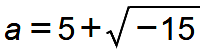 and
and 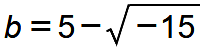 ): Although these numbers are not on the real axis and leave the realm of sensuality, their addition results in the directly recognizable natural number 10, and when they are multiplied, a new complex number is found in a rotary motion, which in turn lies on the real axis and results in the natural number 40. This is the archetype of the re-entry
  considered by Spencer-Brown (see the article on Imaginary numbers, Tydecks 2017).
– Frege defined terms by their courses-of-value (others translate: value-range) (Frege 1891/1984, 142). To put it graphically, this is the graph of a function. For example, the temperature curve and the blood pressure curve are value curves that describe the state of health. In some rocks, fault lines can indicate the course of geological changes. For Frege, the course-of-value is the extension of a concept. We only know about a thing what we can read off and generalize from its course-of-value. He hoped to show that every concept can be determined by its course of value, i.e. descriptively.
– From Wittgenstein's point of view, the course of value can be seen as an example of a propositional sign. This is an unusual and misleading expression: it does not refer to punctuation marks such as points, commas or question marks, but in the same way that a course of values describes a concept, a sentence or a related group of sentences can describe a concept. While the courses of value meant by Frege are sensually vivid, sentences can be used to describe concepts for which there are no visible or otherwise measurable quantities and their courses of value, such as the concepts 'soul' or 'worry'. They can only be made comprehensible with words, stories and possibly images of typical situations. If a sentence describing a term is itself taken as a unit, we can speak of a propositional sign: the sign of something that shows itself in this sentence. In a literal sense, this is a sign that encompasses the statement of a sentence in an image (icon, imago) and stimulates the imagination to understand it (WTLP, 3, 3.1, 3.12). A sign shows more in itself than can be said in words. Thinking further, this leads to the question of whether a language is conceivable whose signs have a far greater expressive power than the language we know. The science fiction author Samuel Delany explored this in a playful and creative way in his 1966 novel Babel-17. He gives the following example: If there is no distinction between I and you in a language, or between different genders, this shapes our thinking in a fundamentally different way than we are used to. This applies, for example, to the formal language of logic and programming languages. Conversely, the idea of a language can be designed that can stimulate our thinking far more than the languages we are familiar with. Similarly, in music, the question is asked whether there are unique melodies that immediately change the state of the listener (according to Helmut Krausser in his 1993 novel Melodien with examples such as the Miserere by Gregorio Allegri, probably composed in the 1630s).
Spencer-Brown recognized the inner connection: If not only real-valued functions (“single-valued functions”) and their graphs are considered as by Frege, but also functions in the realm of imaginary values, then their oscillating graph shows the solution of conflicts such as Russell's antinomy and other paradoxes (LoF, 97). As an example, he uses the oscillator function to name the value progression of 'true' and 'false' in the liar paradox: if the sentence “this sentence is false” is true, it is false, and if it is false, it is true, and so on (LoF, 60f). The liar paradox is neither true nor false, nor does it assume any of the other proposed truth values such as 'uncertain' or 'unimportant', but it is in a different state that can only be described by the oscillating graph of a function that runs in the domain of imaginary numbers. The circular and hyperbolic functions, such as the oscillator function, are represented mathematically using Euler's formulae with imaginary numbers.
The imaginary state is certainly not identical to the unmarked state, but emerges from it in a precisely defined way. Traditional mathematics reduces the question of imaginary numbers and their states to the introduction of a new calculus (the algebra of complex numbers with its own algebraic operations) and does not see the idea that Spencer-Brown is concerned with. Spencer-Brown shows how the imaginary state provides a new view of the unmarked state.
– Stable and unstable states Physical and technical view. The decisive factor is the memory function. When is it possible to rely on memory? This only applies in stable states. There is always an unknown residual instability, which physics and technology try to determine using perturbation theory and technology assessment. The unmarked state becomes the unstable state. Instability arises when the rule is disturbed and changes. (LoF, 64). Only in the stable state can the same rule be applied continuously and memory be trusted.
– Possible (virtual) and real states Developmental idea. States of different centrality.
However, unstable states are not only states of uncertainty and unpredictability, i.e. they have a deficiency. Only from unstable states can something new emerge. “All that is not information, not redundancy, not form and not restraints—is noise, the only possible source of new patterns” (Bateson 1972, 418)
This is how the unstable state becomes the space of possibilities. This is where the “formal seeds” lie. For Spencer-Brown, they are “in a less central state” (LoF, 101). These are obviously states of different potentiality (virtuality) (see Leibniz and Gödel).
This corresponds to the definition of a fiber in differential geometry. The fiber represents the totality (mathematically: the space) of all possible movements of an object. In the language of field theory, it represents the internal degrees of freedom. The elementary example is the tangent space: it shows the directions and velocities with which a given object can move at a given position. The tangent bundle is the totality of all tangent spaces. The actual trajectory of motion is a section through the tangent bundle, showing the path an object has taken from one position to the next and describes as a whole. This can be seen as a radical extension of the concept that Frege already anticipated with his 'course-of-values'
– mental states (parasitic, creative) Thinking like this requires imagination and creativity. Spencer-Brown gives the last section of chapter 11 the title Coda. There, another change of meaning occurs: The marked / unmarked or stable / unstable states become “various states of mind which we put upon ourselves” (LoF, 68). What can be meant by this becomes clear in the note to chapter 11, when a distinction is made between parasitic and creative (LoF, 102).
Is the term 'parasitic' suitable? With polemical intent, it means that the parasite is completely dependent on its host, lives from its power, energy and creativity and can only parasitize on it. This also applies to science when, on the one hand, innovators violate the existing rules and find themselves exposed to harsh criticism, while on the other hand, conservatives can feed off what innovators have introduced before them. “All applied science is seen as drawing sustenance from a process of creation with which it can combine to give structure, but which it cannot appropriate.” (LoF, 102)
I would like to add the distinction between paralyzed states and states full of energy. It can be used to describe phenomena that are of immediate political relevance today, when entire societies fall into a state of polarization and mutual blockade. Conversely, it is the question of the energy of form that can be used to describe states of form in which we can speak of openness and stimulation.
– Second-order states Overall, there is an insight into second-order states: the different states in which a state can be. Is there an energy that leads from one second-order state to the next? Is this second-order energy the measure with which the entire process stimulates and fuels its observer and their mental activity?
Epigenetic landscapes (Mons philosophorum)
What is the relationship between first- and second-order states? By which pathways do they emerge from one another? Differential geometry provides the general framework for how independent forms, their connections, and the paths between them can be mathematically formalized. A subsequent paper will demonstrate how the call, the tunnel, and the re-entry can be understood in this manner. At this point, it is more straightforward to represent the variety of paths leading to second-order states using diagrams of the epigenetic landscape, which trace back to the work of Waddington in 1957. This model, in turn, stands within a historical line of development reaching back to Gödel, Turing, McCulloch, and Pitts, as has been shown by (Abraham 2000).
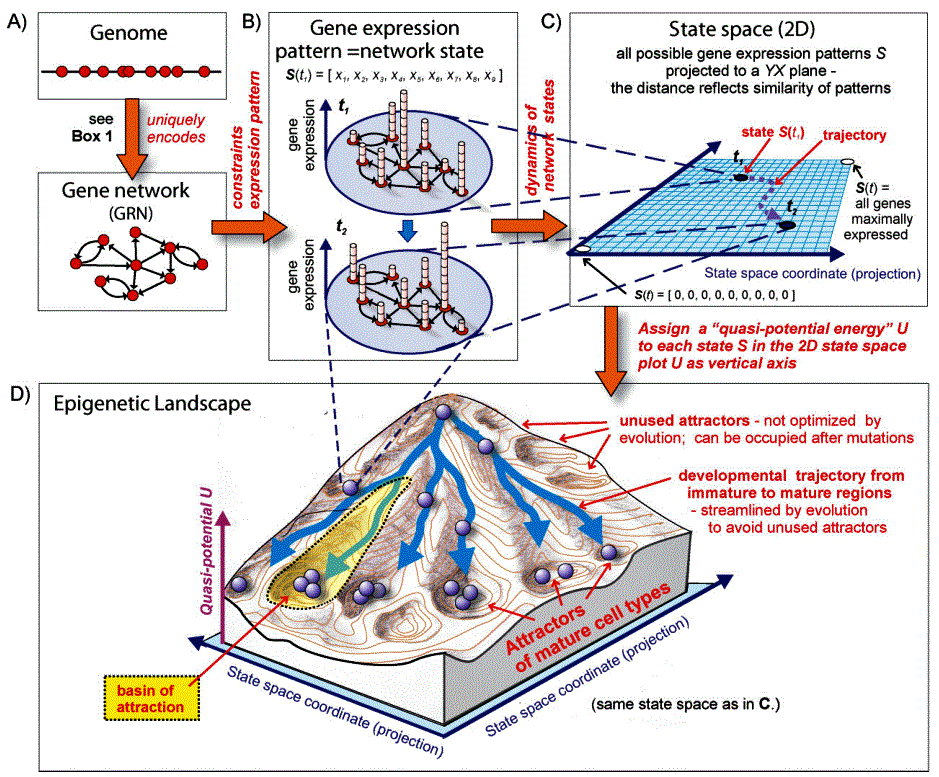
Epigenetic landscape. Source: Huang 2012b, 151
The image of an epigenetic landscape goes back to Waddington's earliest work on epigenetics (Waddington 1957/2014, 29). While the progressions along the streams show how development is controlled by genes, the influences of the contour lines show how epigenetics can alter genetically controlled behavior. This representation has since been transferred to the description of other biological processes such as the development of cancer and tumors..
At this point, it must be sufficient to give a few hints as to how this image can be used to describe the states of form:
– The basis are cellular patterns and their transitions, whose formal foundations can be described with the Laws of Form. These are first-order states.
– The patterns are entered in a space that is spanned by a real and imaginary axis. The complex-valued courses of values mentioned by Spencer-Brown can be visualized in this space.
– The flow curves correspond to the respective marked state. What lies beyond the contour lines remains unmarked. The contour lines are the conflict lines. It is not possible to decide along the contour line into which valley the descent will take place. From the perspective of a valley, what lies beyond the contour lines is open.
– Attractors show blockages and the parasitic mental state. The movement only circles around itself and is unable to recognize any alternatives. Everything is in a state of drying up and dissolution. In contrast, a water cycle must be added, which is not shown in this diagram: the streams and lakes of the attractors soak the ground until the water rises within the mountain, causing the streams at the top of the mountain to gush and bubble. This is the state of natural reproduction and fertility. If the mountain is seen in its vitality, we can speak of the Mons Philosophorum, the flourishing mountain, an alchemical image that the founders of modern science such as Newton and Leibniz certainly knew and were more or less consciously guided by, even if, as far as I know, it cannot be explicitly proven in their published works. I see related ideas in Spencer-Brown when he talks about enlightenment.
This drawing was created as part of work on the development of tumors and cancer. Every living organism continuously undergoes numerous mutations, which in most cases damage and impair the control mechanisms (the information stored in the proteins and genetic material), but which can also lead to revolutionary innovations. No progress without the risk of failure. This can lead to the development of independent life processes within the body that can damage and kill the host body, or improve its life process, such as the viruses that protect an embryo from the mother's immune system. The attractors develop a momentum of their own in relation to the surrounding overall flow.
This image applies not only when marked and unmarked states can be distinguished on the sensory level, but also on the meta-level, when the history of scientific theories and their development processes in turn correspond to the image of an epigenetic landscape.
List of Abbreviations
LoF = Spencer-Brown, G. (1969) Laws of Form. New York: Julian Press, 1972 edition [Online]. Published by siese.org. Available at: siese.org.Note: Citations in the text refer to the page numbers of the Julian Press edition.
TWA = Hegel, G.W.F. (1969–1971) Werke in 20 Bänden [Works in 20 Volumes]. Newly edited edition based on the works of 1832–1845. Edited by E. Moldenhauer and K.M. Michel. Frankfurt am Main: Suhrkamp.Note: Citations in the text refer to the volume number followed by the page number (e.g., TWA 5, p. 435).
WTLP = Wittgenstein, L. (1922) Tractatus Logico-Philosophicus / Logisch-philosophische Abhandlung. Side-by-Side-by-Side Edition, edited by K.C. Klement. Available at: http://people.umass.edu/klement/tlp/ [Accessed: 8 June 2026]
Literature
Abraham, T.H. (2000) Microscopic cybernetics: mathematical logic, automata theory, and the formalization of biological phenomena, 1936-1970. Ph.D. thesis. University of Toronto, Institute for the History and Philosophy of Science and Technology.
Bateson, G. (1972) Steps to an Ecology of Mind: Collected Essays in Anthropology, Psychiatry, Evolution, and Epistemology. London/San Francisco: Chandler.
Blau, U. (2008) Die Logik der Unbestimmtheiten und Paradoxien. Heidelberg: Synchron.
Frege, G. (1891/1984) Function and Concept. In: McGuinness, B. (Ed.) Collected Papers on Mathematics, Logic, and Philosophy. Übersetzt von M. Black et al. Oxford: Blackwell, 137-156.
Huang, S. (2012a) The molecular and mathematical basis of Waddington's epigenetic landscape: a framework for post-Darwinian biology? in: BioEssays, 34 (2), 149-157.
Huang, S. (2012b) Tumor progression: Chance and necessity in Darwinian and Lamarckian somatic (mutationless) evolution. Progress in: Biophysics and Molecular Biology, 110 (1), 9-86.
Kauffman, Louis H. (2014) Iterants, Fermions and the Dirac Equation in: arxiv.org. Verfügbar unter: https://arxiv.org/abs/1406.1929.
Kierkegaard, S. (1844/1984) Der Begriff Angst. Übersetzt aus dem Dänischen von L. Richter. Frankfurt am Main: Suhrkamp, deutsche Ausgabe 1984.
Nguyen, H.T., Kreinovich, V., Shekhter, V. (1998) On the Possibility of Using Complex Values in Fuzzy Logic for Representing Inconsistencies in: International Journal of Intelligent Systems, Vol. 13, 683-714.
Spencer-Brown, G. (1953) Statistical significance in Psychical Research in: Nature 172, 154-156.
Spencer-Brown, G. (1957) Wahrscheinlichkeit und Wissenschaft. Übersetzt aus dem Englischen von H.G. Holl. Heidelberg: Carl-Auer-Systeme, deutsche Erstausgabe 1996.
Spencer-Brown, G. (1965a) Improvements in or relating to logical property switching circuits. British Patent Specification 1006018. London: Patent Office.
Spencer-Brown, G. (1965b) Lift control circuit arrangement. British Patent Specification 1006019. London: Patent Office.Die Bestandteile im Detail:Spencer-Brown, G. (1965b).
Spencer-Brown, G. [Pseud. J. Keys], 1971 Only two can play this game. Cambridge: Cat Book.
Tydecks, W. (2017) Imaginäre Zahlen – Wie aus der Wissenschaft mathematische Intuition wird. Bensheim. Verfügbar unter: http://www.tydecks.info/online/themen_zahlen_imaginaer.html [Accessed: 8 June 2026].
Waddington, C. H. (1957/2014) The Strategy of the Genes: A Discussion of Some Aspects of Theoretical Biology. London: Routledge.
 |
 |
|---|
© tydecks.info 2024