Walter Tydecks
Cantor's Hidden Conclusion on the Divine
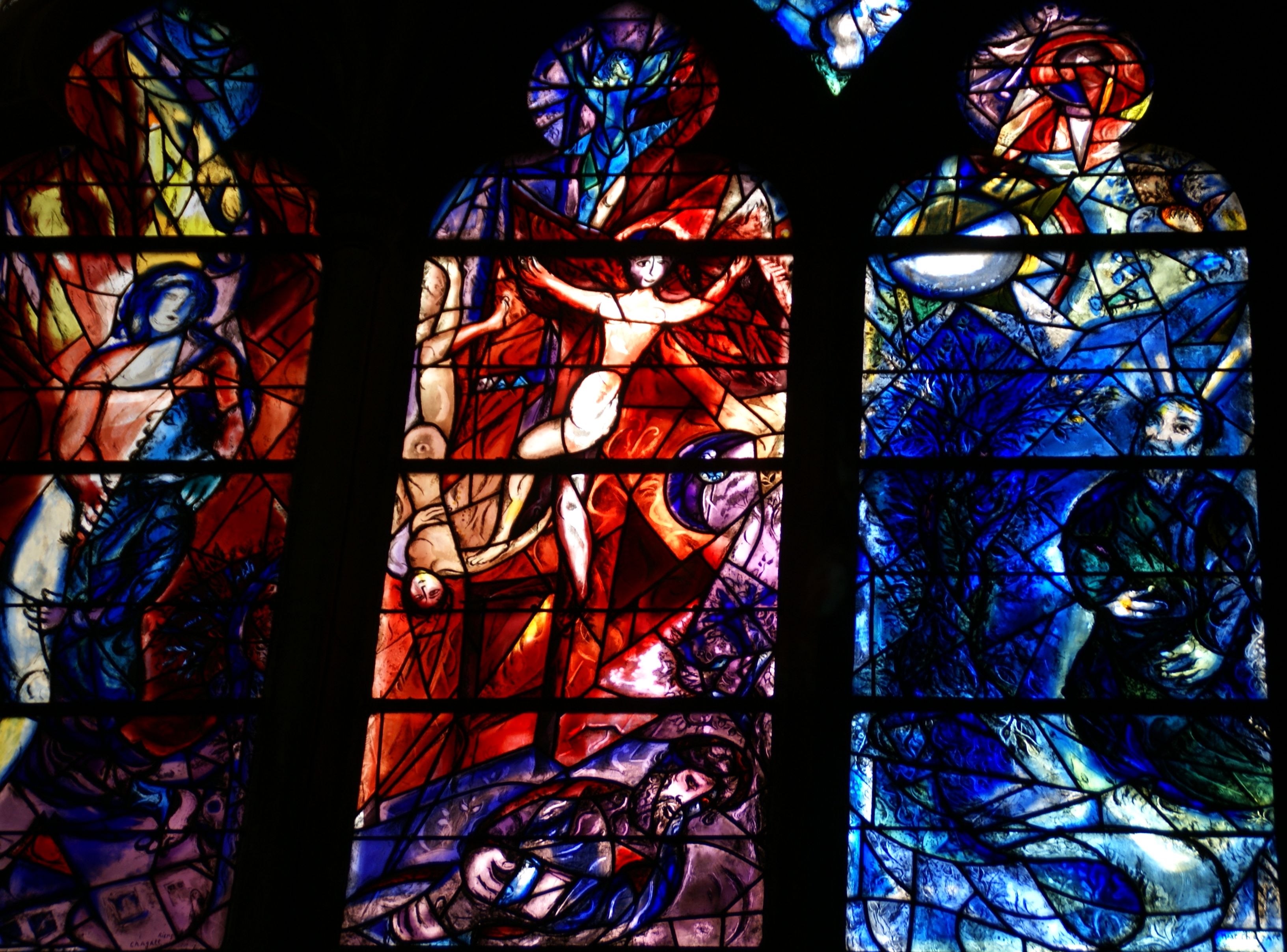
Jacob's Ladder: Chagall Window in Saint-Étienne Cathedral in Metz, 1962-1969 (own photo)
Table of Contents
Introduction
Cardinality: Names of Numbers and of Nothingness (from Cantor to Derrida)
Individuality: The Hidden and the Impossible (Cantor, Husserl, Gödel)
Processuality: Cooperation and Community (Cantor and Leibniz)
Published in: Claire Hill, Walter Tydecks (ed.) Georg Cantor's Metaphysical Correspondence. College Publications, 2026.
Download as pdf-file
Introduction
What is the divine in mathematics that gives it its unique position between the natural sciences and the humanities? God cannot be proven like a thing or a theorem, but from mathematical work one can infer the divine given with it. In a letter to the Franciscan Ignatius Jeiler, Cantor wrote on May 20, 1888, "that everything finite (and, I further add, to a still greater extent to everything transfinite) leads directly from the most diverse sides to the Absolute, i.e., necessarily allows us to infer the existence of the Absolute through dialectical syllogism of reason (Vernunftschluss)" (Tapp 2005, 417). Starting from the finite, the mathematical syllogism of reason leads beyond the countably infinite (ℵ₀) and the uncountably infinite (ℵ₁) to the process itself, the progressive extension of the number classes as pure actualization of possibility. If the inner dynamic of this movement is perceived, the divine reveals itself therein: not as the paradoxical set of all sets, as abyss and dissolution of all logical thinking, but as an open, living process. It manifests itself in the image of Jacob's ladder (Gen 28:10-22), whose rungs multiply infinitely in the ascent, while the Absolute remains simultaneously inner impulse and inscrutable eternity. From the life memoirs of Cantor's student Gerhard Kowalewski (1876-1950) it is recorded: "These cardinalities, Cantor's alephs, were something holy to Cantor, so to speak the steps that lead up to the throne of infinity, to the throne of God." (Kowalewski 1950, 201).
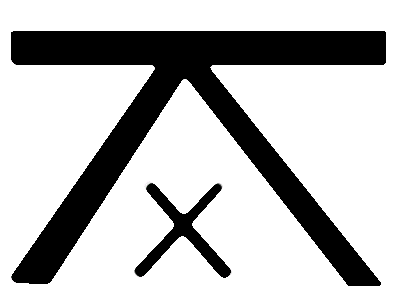
Due to the prevailing Enlightenment and the materialistically and empirically oriented positivism of his time, Cantor could not express himself openly about this. To gain scientific acceptance, he proceeded deliberately formally in his mathematical publications and largely refrained from explicit metaphysical and theological arguments. When he did do so, he immediately encountered harsh resistance. The concepts he introduced into mathematics—'well-ordering', 'cardinal number' (cardinality), and 'power'—do not directly reveal their philosophical and theological background. For him, they have an exoteric and an esoteric side. As technical terms of mathematics, they have long since become established, but their broader ideological content remains hidden. In choosing his terms, expressions, and newly introduced symbols, Cantor often proceeded pragmatically: simple and appealing symbols were important to him, such as ω for the transfinite numbers and ℵ for the cardinalities. Yet his letters reveal his deeper concern and his intensive engagement with religious and philosophical currents of all kinds. Even though he was a convinced Christian and on December 17, 1885, asked Cardinal Franzelin whether his mathematical ideas remained within the framework of Catholic doctrine (Briefe, 252, as well as Tapp 2005, 320), the as-yet-unpublished letters beyond the existing collections by Tapp (2005) and Décaillot (2008) document his largely unknown intensive engagement with occultism. A letter to the occultist Carl Kiesewetter (1854-1894) dated August 25, 1891, he signed with the symbol  , which resembles the sign
 and stands for a step (a method) in the alchemical Opus Magnum (something like grasping and extracting something from a fire with tongs, where the loop at the bottom right is the sign of Saturn), as Manuel Bachmann brought to my attention. With this, Cantor came into opposition to the positivist currents of his time and had few opportunities to speak openly about this with other scholars and elaborate on these ideas.
I see four basic principles in Cantor's thinking:
(i) Cardinality (the most important, the pivotal point) of numbers: There is no substance of numbers, but rather a triadic interaction of numbers (number classes), their names (and their symbols), and the ordering process. Numbers are not possible without already having the names for the numbers and without having an ordering process (of counting and set formation) at one's disposal. Names for numbers are not possible if there are no numbers to which they can refer, and no ordering process within which they can unfold their effect. The ordering process is not possible if there are no numbers that can be ordered, and no names with which ordering succeeds. For Cantor, cardinality designates the steps of Jacob's ladder, leading from the finite through the countably infinite (ℵ₀) to the uncountably infinite (ℵ₁) and finally to the immediacy of the Divine in the process of number classes. Cantor's choice of the aleph symbol (ℵ) (first used in 1895; Abh, 289) must be seen against the background of the Kabbalistic renaissance of the 19th century, when, for example, occult orders like the Ordre Kabbalistique de la Rose-Croix, founded in 1888—which Cantor knew very well (see his letter to Kiesewetter of September 9, 1891)—placed the aleph in the center of the Rosicrucian motif. For both, the aleph symbolizes the inexpressible primordial ground of God.
(ii) Individuality (the respective particular and unique) of numbers: Something is only countable if it shows itself and stands out as an individual against a background (medium) that itself is usually not perceived at all. In every counting, a selection is made—usually unnoticed—and everything that lies between, before, beneath, or beyond the counted objects is skipped and not counted. In a counter-movement, counting leads out of itself to a higher hidden realm: the process of counting points to the transfinite numbers, which are to be imagined beyond the visible (countable) numbers, and to the continuous numbers, which blur intangibly between numbers.
(iii) Processuality (mobility, dynamics) of numbers: The countable things manifesting in pluralities must stand in an inner relationship to one another in order to be able to be counted together as a set. Cantor understands a set step by step as a collection, a manifold, and with clear reference to Leibniz as a monadology. Thus Cantor's understanding of numbers leads to insight into the commonality of the countable, their cooperation, and finally the spiritual agreement in a community.
(iv) Immediacy of the Divine: The Divine (the Absolute) transcends every determinability by humans, but it show itself in the process of gradual ascent in number classes with progressively greater cardinality. It is present in this process and reveals itself in it. Humans can only conceive of it, whether in dreams like that of Jacob's ladder or in the symbols with which the infinite has been represented in the history of human thought. The ordering process points to the all-goodness of God, without which this would not be possible.
– The image of Jacob's ladder
Jacob's ladder has parallels in the ladders (Scala Philosophorum and Scala Naturae) of Renaissance thought (Ramon Lull, Agrippa von Nettesheim, Guido de Montano, Franz Roll, and many others) and in particular to the scales calculated by Kepler in his World Harmony. “Now it must sound louder, Urania, as I ascend to greater heights on the harmonic ladder of heavenly movements, to where the true archetype of the structure of the world is hidden and preserved.” (Kepler 2006, 310) Cantor studied all of this. Without mentioning Jacob's ladder, the ladder is the decisive point at which he turns away from tradition. For him, there is no simple juxtaposition of the finite and the infinite. Rather, they are connected by a ladder along which the infinite can be differentiated more precisely. Although “the true infinite or absolute, which is in God, does not allow for any determination” (Abh, 175),
"What I assert and believe I have proven through this work, as well as through my earlier attempts, is that after the finite there is a Transfinitum (which one could also call Suprafinitum), i.e., an unlimited ladder of determinate modes which are by their nature not finite but infinite, but which, like the finite, can be determined by specific, well-defined and distinguishable numbers." (Abh, 176)
Just as Kepler arranges the planets as steps of a musical scale in the Harmonices Mundi—with Saturn and Jupiter as the bass foundation—so Cantor structures infinity in aleph-steps. Jacob's ladder here becomes a mathematical harmony of the spheres
Cantor's diagonal argument is an action on Jacob's ladder, leading from the countably infinite to the uncountably infinite numbers, and itself has the construction of a ladder: it constructs the uncountability of the real numbers by stepwise generating from every countable list a new number that lies outside the list. Yet the ladder has limits: Gödel's incompleteness theorems and Russell's paradox show through negative self-reference that the highest step—like Saturn in Kepler's harmony of the spheres—remains unattainable and points to the absolute infinite of God.
Cardinality: Names of Numbers and Nothingness (from Cantor to Derrida)
What is the cardinality (power) of a thing? For Cantor, it serves to grasp the respective numerical property of the ascending infinities along Jacob's ladder. He considers various possibilities until he recognizes the significance of names.
The transmitted traditions of religion, magic, and science had spoken of symbols that possess their own power or convention. For Cantor, symbols are abbreviations for already defined concepts; for example, he introduces the Greek letter φ for variables (Abh, 125) and calls this a "symbolism" (Abh, 130). Or he speaks of "symbols of infinity" (Abh, 149). They are signs for something already known.
Symbols can be arbitrary and agreed upon by mere convention, independently of the respective thing, in order to ensure, for the sake of common research, that with a sign used by all, the same thing is being spoken about. In contrast, representatives are contentually determined. Cantor designates as representatives structural proxies (instances) of general states of affairs; for example, the interval [0,1] represents the class of all continuous sets (Abh, 142), and the aleph numbers are "representatives of the systematically ascending cardinalities of well-defined sets" (Abh, 167). They do not, like symbols, designate something known, but are taken as exemplary instances from a more general structure for which they stand as proxies.
Representation resembles the rhetorical figure of synecdoche (literally "taking together," often referred to in German as "Stellvertreter-Bild" [proxy-image], e.g., when speaking of 5 sails meaning 5 ships). Both use exemplification (a single case represents the whole). Yet while synecdoche often seems arbitrary (any striking feature can be used), mathematical representation chooses characteristic examples that clarify the differentia specifica (the essential distinguishing feature) of a class.
Cantor was aware of the necessity of rhetorical devices and used them masterfully: metaphors from everyday language, e.g., "diagonal argument" (like a craft process), "well-ordering" (ethically charged); catachreses (rhetorical "makeshifts") for previously unnamed things; neologisms (newly created "concept-formations"). Particularly ω shows Cantor's genius balance: It appears like a normal number (in the series 1, 2, 3, …), and simultaneously breaks with intuition (it is not a point on the number line).
ω and ℵ are therefore more than symbols or representatives. They are names. Cantor emphasizes their special status: They "seem important enough to me to justify special designations and names" (Abh, 270). How seriously he took naming, he wrote on October 20, 1884, to the mathematician Mittag-Löffler: he had now succeeded "in introducing names for several new important concepts, in the choice of which I am extraordinarily cautious, since I proceed from the view that for the development and dissemination of a theory, a felicitous, as accurate as possible naming is by no means insignificant" (Briefe, 212). The result he summarized in a letter of July 28, 1899, to Dedekind: "The cardinal numbers which pertain in this sense to the transfinite numbers of the system Ω I call 'alephs', and the system of all alephs shall be called ת (Taw, the last letter of the Hebrew alphabet)", just as ω is the last letter of the Greek alphabet (Abh, 445) and stands for the completion of the ordinal numbers. They are of ontological and theological depth. Even nothingness (the empty) receives a name with which one can operate mathematically: "Furthermore, it is expedient to have a sign which expresses the absence of points; we choose for this the letter 0; P ≡ 0 thus means that the set P contains not a single point, therefore strictly speaking as such does not exist at all." (Abh, 146).
From this later developed the symbol ∅, introduced by the French mathematician André Weil (1906-1998, brother of the philosopher Simone Weil) "from the Nordic languages" (Deiser 2010, 31 with reference to Bourbaki's Éléments de mathématique of 1939, where ∅ is introduced in greatest generality as a symbol for an empty word and, building on that, for an empty set and an empty function; Bourbaki 2004, 50, 71f, 82). In Nordic languages, the slashed O stands for a vowel pronounced like German 'ö' or 'œ', e.g., Danish 'fødsel' (birth). Hardly any mathematician notices that ∅, the symbol of the empty set, represents a paradoxical reversal: a Nordic vowel sign (ø), embodying linguistic presence, becomes the name of nothingness—absolute absence. This recalls Derrida's différance (with *a* instead of *e*), which marks the phonetically indistinguishable difference from différence and deconstructs the metaphysics of presence. Both signs subvert the expectation of presence: ∅ formalizes emptiness as cardinality of the zeroth level, since Bourbaki an operative foundation of set theory, while différance remains an unclosable play, a non-clôture that refuses any ontological determination (Derrida 2004, 122, 129f, 139). Cantor's O and later more clearly ∅ is a catachresis that names the unspeakable of emptiness and makes it mathematically manageable, yet through its Nordic origin (ø → ∅) preserves a trace of the repressed. In contrast to Derrida's deconstruction, which points into the indeterminate, ∅ integrates the cardinality of nothingness into Jacob's ladder.
Naming is a sacred act, like the baptismal name and the names of God. Agrippa always begins his six-step ladders of numbers with a divine name from the archetypal world, e.g., the ladder of unity with the monogram of the single Hebrew letter Yod (י), the ladder of five with the name of God in five letters (Pentagram) (Elion, Elohim, Ihesu) (Agrippa 1987, 196, 211). Just as Kepler's Saturn is the last nameable sphere before God, ℵω is the last nameable step before the Absolute.
Individuality: The Hidden and the Impossible (Cantor, Husserl, Gödel)
How does the Divine show itself in the individuality of numbers? Numbers gain individuality when, thanks to their power (potestas), they are capable of acting and, through their action, attain their respective uniqueness both within the number class and in the course of the counting process. This individuality unfolds in four steps: concept of agency, ascending and descending the ladder, disclosing the hidden, consistent community formation. – This presentation draws on elements of the works of Cantor and Husserl and brings them into a new systematic context.
(i) Cantor's concept of the actual-infinite means not only presentness (the infinite set can be fully actualized in the abstraction process of thought), but also literally Actus (deed, action): the capacity of numbers to effect and act.
Cantor himself, however, does not speak of Actus or agency, but of the power (Mächtigkeit) that enables it. Here a duality in his thinking becomes apparent: Exoterically (publicly), he defines power as the number of elements of a set. For finite sets, it corresponds to the positive integer (Abh, 119). For infinite sets like the set of all natural numbers ℕ, the principle of one-to-one correspondence applies (two sets have the same power if all their elements can be mapped bijectively onto each other) (Abh, 151). Up to this point, his critics followed him. Esoterically (inwardly oriented), power is a dynamic force—a potestas that enables numbers to act and integrate themselves into the hierarchy of the infinite.
To ground higher infinity, Cantor drew on Platonic ideas. In a letter to Eneström (1885, publ. 1890) he speaks of "arithmoi noetoi or eidetikoi" (literally: "thought numbers" or "form numbers"; Abh, 372). This concept alludes to Plato's ideal numbers (cf. Parmenides 144a, Philebus 56d-e), which were first made explicit by Aristotle (Met I.6 987b20-22; V.14 1020b; XIV.5 1092a23-24).
Cantor studied Neoplatonic, Hermetic, and occultist traditions (Proclus, Kabbalah, Agrippa von Nettesheim, John Dee, up to contemporary occultists like the Frenchman Papus and in Germany Carl Kiesewetter) and adopted from them the consciously broad concept of power. Thus he could reveal his standpoint to "initiates" while concealing it from the public.
A key passage is his letter to Hilbert (January 27, 1900):
"I hope, on the contrary, soon to be able to convince you that my necessary immersion in the spirit of the 16th and 17th centuries has led me to grasp and understand the mathematical and scientific classics of that time more precisely than has hitherto been possible for others. [...] For example, I will, on occasion, introduce you to a mathematician born in 1527, J[ohn] D[ee], whose edition of Euclid with commentaries must particularly interest you." (Cantor, Briefe, 425)
(ii) Numbers act when they ascend and descend the steps of Jacob's ladder from the finite through the countably infinite (ℵ₀) to the uncountably infinite (ℵ₁) and beyond. Cantor's diagonal argument demonstrates how this is possible: From any list of countably many real numbers (e.g., all rational numbers or all algebraic numbers), a new real number can be constructed by considering their diagonal representation that is not contained in this list—and thus points beyond the initial set. At first glance, this appears as the work of a mathematical "craftsman." Yet behind it lies the potential disposition of the numbers themselves to transition into higher cardinalities. Cantor generalized this and conjectured that the transition from a set to its power set (the totality of all its subsets) generates a new cardinality—the continuum hypothesis (cf. Abh, 132, 168f). Its proof has not succeeded. Apparently, it is necessary to grasp the esoteric concept of power—as an acting force—more deeply.
This is precisely what Gödel addressed in What is Cantor's Continuum Problem? (1947/1964). For him, the core of the continuum hypothesis lies in the formula
ℵi+1 = 2ℵᵢ
– that is, the calculation of the successor ℵi+1 from a given ℵi. Since this is not provable from the existing axioms, Gödel demanded a second principle: "there exists another (though only probable) criterion of the truth of mathematical axioms, namely their fruitfulness in mathematics and, one may add, possibly also in physics" (Gödel 1990, 269). This "fruitfulness" (a term Cantor also used occasionally; cf. Abh 182, 407) is only comprehensible from a Platonist stance: "from the fact that even our ideas referring to physical objects contain constituents qualitatively different from sensations or mere combinations of sensations, e.g. the idea of object itself." (Gödel, 268)
While ordinary natural numbers are derived from sensory perceptivity (e.g., by counting apples), "fruitful" numbers are entities capable of action with their own ontological depth. Only for such numbers can statements like the continuum hypothesis be made.
(iii) This freedom of movement leads numbers beyond the natural numbers 1, 2, 3, … (the positive integers) and discloses the hidden (zero, negative, fractional, irrational, and imaginary numbers). Husserl emphasized that this is not merely a consequence of "higher" idea-numbers, but is implicitly fundamental to ordinary mathematics. Husserl (1859-1938) was in Halle from 1886 to 1901 and there was not only a colleague of Cantor (1845-1918), but they were good friends (see the biographical portrait by his wife Malvine, also Hill 2017, 169-171).
He observed: Mathematicians speak naturally of zero or imaginary numbers, although these do not correspond to any empirical intuition—unlike natural numbers, which are countable on objects (apples, spheres). Nor is it a matter of abduction (like the prediction of a planet from orbital deviations of known planets), which can later be confirmed. The existence of something with a "number of zero" or a "negative number" is neither predictable nor empirically demonstrable. To make this clear, Husserl speaks of the "passage through the impossible" (Husserl, title of double lecture 1901). His task: To recognize the laws of motion of numbers and demonstrate their consistency, even though they will never be empirically verifiable. This difficulty explains why students often do not understand what zero or negative numbers are. In teaching, this is usually glossed over; only results are referred to, but not the discovery and the securing of the path of calculation, which passes through the impossible, returns successfully from there, and yields results that are in turn empirically verifiable. Husserl takes the stupid questions of students seriously and conversely criticizes professional mathematicians who have unlearned to account for the foundations of their activity. It is not enough to define negative numbers from the inversion of addition and pose problems such as, how many people are in a bus if 10 people get off when there were 8 passengers. Every child has to laugh, but the mathematician says without hesitation, then there are minus-two people in the bus.
Only those who acknowledge this difficulty can ask: Thanks to which rules does calculation with impossible numbers nevertheless yield meaningful results? In the example of negative numbers, it is the rule 'minus times minus equals plus'. This rule is intuitively just as non-intuitive as negative numbers, but with it, it is ensured that calculation with negative numbers can return to the positive natural numbers. Corresponding rules must be established for the other impossible numbers. The best-known example is why, in calculus, division by zero is allowed, although it is otherwise forbidden. It is these rules that make calculation with impossible numbers consistent.
To characterize such numbers, new signs must be introduced: Negative numbers used to be written in red, and when the minus sign does not only, as usual, mean the operation of subtraction, but signifies a negative number, for example minus-two (-2), it distinguishes negative numbers from the usual natural numbers. The same applies when, for irrational numbers, the root sign √, for transcendental numbers symbols like  or e, for differentials dx or ∫, and for imaginary numbers i are introduced. They describe numbers that are hidden in everyday life and are only valid for the process of calculation. For everyday dealing with numbers, they are impossible.
Cantor went consistently further: He developed for the transfinite a new nomenclature with letters from the three sacrae linguae (Hebrew, Greek, Latin). These signs are not mere notations, but constitutive parts of his thinking—a semiotic creation that makes infinity thinkable. Husserl is aware of this. He speaks of ideation (eidetic intuition) (already in the Logical Investigations and further elaborated in Ideas Pertaining to a Pure Phenomenology and to a Phenomenological Philosophy; Husserl 2009, 11 fn. 2).
Cantor and Husserl reject naive empiricism: Infinity is not depicted, but actively disclosed. Both can name their limit: Cantor with the absolutely infinite (God), Husserl as the horizon of the lifeworld.
The ladder is bidirectional: The infinite 'gives itself' (shows itself) from above in descending and revelation for man (Cantor), and conversely man ascends with the capacities of his consciousness (Husserl). For Cantor, God secures the consistency of the alephs. For Husserl, the transcendental ego secures the unity of the successively constitutive steps.
The names are the bridges between the two. They are neither mere signs nor mere subjectivity, but performances of a common reason. Cantor's infinite is unthinkable without Husserl's constitution, and Husserl's constitution finds in Cantor's names for the steps of the infinite its clearest mathematical expression. Jacob's ladder connects what belongs together: the Logos of heaven and the spirit of man.
One step remains open for Cantor and Husserl: How do the impossible numbers arise? From the natural numbers and their arithmetic operations, it must be shown that they lead out of themselves to gaps where the impossible numbers originate. This is only possible with the dialectical thinking of Hegel and Gotthard Günther, an approach Cantor, however, comes very close to with his idea of the "dialectical syllogism of reason."
(iv) This prepares the inference from cardinality through individuality to processuality, in which the Divine shows itself. Numbers capable of action can cooperate and the sets formed from them become consistent. Numbers can form communities in which the Divine shows itself (living community).
Processuality: Cooperation and Community (Cantor and Leibniz)
It concerns the inference from (i) consistency, thanks to which sets (Cantor) or methods (Husserl) preserve their inner coherence, through (ii) the active, community-forming moment contained in them, to (iii) the insight: Elements not only have affinity and unite into communities, but they pursue a common idea and form a community (Gemeinde).
(i) Cantor initially conceived the ladder of infinity mathematically: Finite numbers can be gradually increased into infinity. For every finite number n there is a successor n + 1; and conversely, except for the One, every finite number n has a predecessor n - 1, which is also finite. Cantor defined the cardinal number as the number of elements of a set and called the number of all natural numbers ω, the first transfinite ordinal number. This in turn has a successor ω + 1, but unlike finite numbers, its predecessor is infinite. His goal was to show that the totality of all transfinite numbers itself has a cardinal number (e.g., ℵ₁), from which one can proceed to the next higher cardinal numbers. How this can be achieved is the content of the diagonal argument and the continuum hypothesis. Yet Cantor always distinguished from these transfinite steps the absolutely infinite, which is not augmentable and has neither predecessor nor successor. He defended this idea in numerous letters, especially in the letter to Cardinal Franzelin, who agreed with him that with this distinction Christian doctrine is preserved.
Nevertheless, the notion of a "set of all sets" or the "set of all cardinal numbers" proved problematic (see Jané). Simultaneously with Cesare Burali-Forti (1861-1931) from Peano's school and shortly before the discovery of Russell's antinomy (1901), Cantor recognized that in such total sets, elements could be demonstrated that contradict each other (inconsistency). Therefore, he newly differentiated his theory: no longer was the distinction between finiteness and infinity paramount, but that between consistent and inconsistent pluralities (letter to Hilbert of January 27, 1900; Briefe, 427). Consistent sets (finite or ℵ-signified infinite) can be thought as a unity; inconsistent pluralities (like the "set of all sets"), on the other hand, lead to contradictions and cannot be grasped as closed wholes.
While for Russell and Frege inconsistent sets meant a logical abyss, Cantor saw in them a new determination of the absolutely infinite. They are not sets in the proper sense, but are accessible only to the divine mind.
"For a multiplicity can be of such a nature that the assumption of a 'being-together' of all its elements leads to a contradiction, so that it is impossible to conceive the multiplicity as a unity, as 'one finished thing'. Such multiplicities I call absolutely infinite or inconsistent multiplicities. As one easily convinces oneself, e.g., the 'totality of everything thinkable' is such a multiplicity; later other examples will present themselves." (Letter to Dedekind, August 3, 1899; Briefe, 407)
Consistency or inconsistency is, for man, a process property. With inconsistent sets, it is not a matter of grasping them as a whole, but of designing approximations to a 'being-together', even if these can never exhaust the whole. Cantor ultimately saw in the absolutely infinite the divine principle and its highest freedom of action (actus purus). Conversely, it becomes apparent that all numbers, order types, and the sets formed from them accessible to man have only limited freedom of action; they are bound to axioms, constructions, and the limits of human reason.
"What lies above all finite and transfinite is no 'genus'; it is the single, completely individual unity in which everything is, which encompasses everything, the 'Absolute', ungraspable for the human mind, thus not subject to mathematics at all, the immeasurable, the 'ens simplicissimum', the 'Actus purissimus', which is called 'God' by many." (Letter to Grace Chisholm-Young, June 20, 1908; Briefe, 454)
With the concept of consistency, Husserl's approach can also be grasped more sharply: It is not enough that axioms are consistent and form "a collection of formal axioms, i.e., a limited number of purely formal, mutually consistent, and independent fundamental principles" (Husserl 2001, 91); they must be capable, in the process of passing through the impossible, of producing common results.
(ii) The question of how consistency arises and remains secured leads to the idea of conatus (inclination, impulse, striving) in Descartes, Spinoza, and Leibniz. With Leibniz, this becomes appetitus, the individual expression of the cosmic conatus. Kant wrote in the first edition of the Critique of Pure Reason: "The ground of the possibility of the association of the manifold, insofar as it lies in the object, is called the affinity of the manifold." (KrV, A 113) The chemistry of the Romantic era took this up and spoke of elective affinity, thanks to which chemical objects react with each other and form new units. Gödel finally elevated "fruitfulness" to a criterion for axioms—their power to produce new propositions and structures. Elements that possess such actively striving properties differ fundamentally from the passive particles of classical mechanics. They are capable of forming orders out of themselves, of rising into higher dimensions, of emerging. Leibniz called them—in reference to the magical thinking of the Renaissance (John Dee, the Kabbalah, etc.)—monads.
Cantor did not express himself directly on this, but his references to Leibniz are well documented. In Über unendliche lineare Punktmannigfaltigkeiten (1883), he discusses Leibniz's stance on infinite numbers (Abh, 175, 179). Later he refers to Leibniz's understanding of differentials as variable quantities (Abh, 374). Above all, however, Cantor adopts the concept of monads in 1885 in Über verschiedene Theoreme aus der Theorie der Punktmengen in einem n-fach ausgedehnten stetigen Raume Gn. Zweite Mitteilung:
"Following Leibniz, I call the simple elements of nature, from whose composition in a certain sense matter arises, monads or units" (Abh, 275).
Alfred Fraenkel reports that Cantor "occasionally held exercises of a philosophical nature, e.g., on Leibniz, in order to elucidate his own theory of the actual-infinite through comparison with his ideas," and emphasizes that as a full professor of the philosophical faculty he had the right "to lecture even on Sanskrit" (Abh, 462).
The idea of cooperation is indirectly present in Cantor: His "monads" (points in space) are connected by well-ordering—a mathematized pre-established harmony. Or, with Agrippa von Nettesheim, to whom Leibniz and Cantor referred: "Unity completely permeates every number; it is the common measure, source and origin of all numbers. [...] Therefore some have called this concord, others piety, still others friendship. [...] Unity therefore relates to the highest God, who, himself one and countable, yet brings forth countless ones from himself and contains them within himself." (Agrippa 1987, 194f) (iii) Thus the higher goal of Cantor's work becomes apparent, a goal he pursued in substance but probably did not formulate explicitly: Just as the presence of God (the Holy Spirit) shows itself in a Christian community, so in the interplay of numbers a community reveals itself that both points to God and connects the numbers among themselves. This transposition is not arbitrary. If tones, letters, and words form communities from which harmony, melody, and meaning emerge, then they possess a common inner logic. Numbers, in their abstractness, are the pure form of this community. The number-community is the transcendental condition of counting, ordering, and operating. In some languages (Hebrew, Armenian), letters and numbers are identical; for Leibniz, music was "a hidden arithmetic exercise of the soul, which does not know that it is counting" (Letter to Goldbach, April 17, 1712; Guhrauer 1846, 66).
Mathematical examples: 3, 4, and 5 in the Pythagorean formula 3² + 4² = 5² form a community that produces right-angledness (the two legs are perpendicular to each other). The numbers e, i, , 1, and 0 unite in Euler's identity eiπ + 1 = 0 to form the cyclicity of the circular function.
The numbers 3, 4, and 5 can be considered individually as simple, independent units. Only when they are placed in the relation of the Pythagorean theorem does a new property emerge: right-angledness. This property belongs to none of the numbers alone, but exclusively to their community. – The situation is similar with the seemingly disparate numbers in Euler's identity: their connection reveals a deep, harmonious unity that transcends the sum of their individual meanings. This is the 'community spirit' of numbers—an emergent property arising from their structural relationship and irreducible to their individual qualities.
The question can also be asked conversely: What gave Cantor the certainty, in the case of inconsistent sets, to think not of dissolution, but on the contrary of the absolutely infinite? Even Kowalewski, well-disposed towards Cantor, saw a drama in this: "One could compare them [inconsistent sets, t] to those unstable chemical compounds that, as soon as they are produced, immediately decompose." (Kowalewski 1950, 208) For Cantor, however, the opposite held: It is precisely community that protects against this. Only it prevents dissolution. Thus a research program opens up—to further develop Cantor's set theory in the sense of Gödel, whose criterion of "fruitfulness" points to the community-forming power of axioms.
Let Leibniz have the final word. Enthused by his discovery of binary numbers, he wrote on May 8, 1696, to Duke Rudolf August (Braunschweig-Wolfenbüttel):
"Since Your Serene Highness graciously recalls the meditation concerning numbers mentioned by me, which represents, as in a mirror, the creation, or the origin of things from God and nothing else, and thus serves to explain to some extent, by the light of reason, this mystery unknown to the heathen (who placed matter alongside God); I have therefore wished to sketch this briefly on the accompanying paper, all the more gladly as I am aware that Your Serene Highness directs everything most laudably to the glory of God, and knows that this is the greatest use of human sciences, when one perceives the rays of divine wonders therein." (Leibniz 1989, 65)
List of abbreviations
Abh = Georg Cantor: Gesammelte Abhandlungen mathematischen und philosophischen Inhalts, Berlin, Heidelberg 1932
Briefe = Georg Cantor: Briefe, herausgegeben von Herbert Meschkowski und Winfried Nilson, Berlin u.a. 1991
KrV = Immanuel Kant: Kritik der reinen Vernunft (1781, 1787)
References
Agrippa von Nettesheim, H. C. (1987). De Occulta Philosophia. Nördlingen: Greno. (Original work published 1533)
Bourbaki, N. (2004). Elements of Mathematics: Theory of Sets. Berlin: Springer. (Original work published 1939)
Bredekamp, H. (2007). Leibniz' transmathematische Schau [Lecture]. Berlin-Brandenburg Academy of Sciences and Humanities. Available at: https://edoc.bbaw.de/frontdoor/index/index/year/2007/docId/519 (Accessed: 20 February 2026)
Cantor, G. (1970). Principien einer Theorie der Ordnungstypen, Erste Mitteilung. Edited by I. Grattan-Guinness. Acta Mathematica, 124, 65-107. (Original work written 1884)
Coudert, A. (1995). Leibniz and the Kabbalah. Dordrecht: Springer.
Dauben, J. W. (1979). Georg Cantor: His Mathematics and Philosophy of the Infinite. Cambridge, MA: Harvard University Press.
Décaillot, A.-M. (2011). Cantor und die Franzosen – Mathematik, Philosophie und das Unendliche. Heidelberg: Springer. (Original work published 2008)
Deiser, O. (2010). Einführung in die Mengenlehre: Die Mengenlehre Georg Cantors und ihre Axiomatisierung durch Ernst Zermelo (3rd ed.). Berlin: Springer. (Original work published 2002)
Derrida, J. (2004). Die différance. Stuttgart: Reclam. (Original lecture given 1968)
Frege, G. (1987). Die Grundlagen der Arithmetik. Stuttgart: Reclam. (Original work published 1884)
Frege, G. (1885). Über formale Theorien der Arithmetik. Jenaische Zeitschrift für Naturwissenschaft, Sitzungsberichte, 94-104.
Frege, G. (1976). Briefwechsel mit Edmund Husserl. In H. Hermes, F. Kambartel & F. Kaulbach (Eds.), Gottlob Frege: Nachgelassene Schriften und Wissenschaftlicher Briefwechsel (Vol. 2, pp. 94-107). Hamburg: Meiner.
Gödel, K. (1990). What is Cantor's Continuum Problem? In S. Feferman et al. (Eds.), Kurt Gödel: Collected Works (Vol. II, pp. 176-187, 254-270). Oxford: Oxford University Press. (Original works published 1947, 1964)
Grattan-Guinness, I. (1971). Towards a biography of Georg Cantor. Annals of Science, 27(4), 345-391.
Guhrauer, G. E. (1846). Nachträge zu der Biographie. Gottfried Wilhelm Freiherr von Leibnitz. Breslau: Ferdinand Hirt's Verlag. Available at: https://books.google.de/books?id=sg1mAAAAcAAJ&pg=PA66&dq=%22Musica+est%22#v=onepage&q=%22Musica%20est%22&f=false (Accessed: 20 February 2026)
Hallett, M. (1984). Cantorian set theory and limitation of size. Oxford: Clarendon Press.
Heidegger, M. (2006). Aristoteles, Metaphysik Θ 1-3 (Gesamtausgabe Vol. 33). Frankfurt am Main: Vittorio Klostermann.
Hill, C. O. (2017). Husserl and Cantor. In S. Centrone (Ed.), Essays on Husserl's Logic and Philosophy of Mathematics (pp. 169-196). Berlin: Springer.
Hill, C. O., & Rosado Haddock, G. E. (2000). Husserl or Frege? Chicago: Open Court.
Husserl, E. (1992). Philosophie der Arithmetik. Hamburg: Meiner. (Original work published 1891)
Husserl, E. (2001). Doppelvortrag Göttingen 1901. In E. Schumann & K. Schumann (Eds.), Husserls Manuskripte zu seinem Göttinger Doppelvortrag von 1901. Husserl Studies, 17, 87-123.
Husserl, E. (2009). Ideen zu einer reinen Phänomenologie und phänomenologischen Philosophie. Hamburg: Meiner. (Original work published 1913)
Jané, I. (1995). The Role of the Absolute Infinite in Cantor's Conception of Set. Erkenntnis, 42, 375-402.
Kepler, J. (2006). Weltharmonik. Edited by M. Caspar. Munich: Oldenbourg. (Original work published 1619; German translation 1938)
Kowalewski, G. (1950). Bestand und Wandel: Meine Lebenserinnerungen, zugleich ein Beitrag zur neueren Geschichte der Mathematik. Munich: Oldenbourg.
Leibniz, G. W. (1989). Sämtliche Schriften und Briefe (Vol. I, 12). Berlin: Akademie Verlag.
Meschkowski, H. (1967). Probleme des Unendlichen. Braunschweig: Vieweg.
Purkert, W., & Ilgauds, H. J. (1987). Georg Cantor 1845-1918. Basel: Birkhäuser.
Schuhmann, K. (1988). Malvine Husserls 'Skizze eines Lebensbildes von E. Husserl'. Husserl Studies, 5, 105-125.
Tapp, C. (2005). Kardinalität und Kardinäle. Stuttgart: Franz Steiner Verlag.
 |
 |
|---|
© tydecks.info 2022-2024